
When engineers, procurement managers, and product designers search for the right motion control component, two terms often come up interchangeably gas lift supports and gas struts. While they share a common operating principle, they are not always the same thing, and using the wrong type in the wrong application can lead to poor performance, premature failure, or even safety risks.
In Malaysia’s growing manufacturing, furniture, and industrial equipment sectors, the demand for reliable gas spring solutions has surged considerably. Whether you’re designing automotive boot lids, hospital bed mechanisms, kitchen cabinet lift systems, or office furniture, understanding the distinction matters. This guide breaks down the differences clearly, so you can specify with confidence. For a comprehensive overview of trusted gas spring products available in Malaysia, the Hahn Gasfedern gas spring range at Eumation is an excellent starting point.
How Gas Lift Supports and Gas Struts Work
A gas strut sometimes called a gas spring or gas pressure spring is a mechanical device that uses compressed nitrogen gas sealed within a cylinder to generate a controlled pushing or holding force. As the piston rod is compressed, pressure builds inside the cylinder, and when released, the stored energy pushes the rod back to its extended position.
The core components of a gas strut include:
- Cylinder typically steel or stainless steel, housing the compressed gas
- Piston rod the moving element that transmits force to the attached component
- Seal system prevents gas leakage and maintains consistent pressure over time
- End fittings ball joints, eye brackets, or clevis mounts that connect the strut to the application
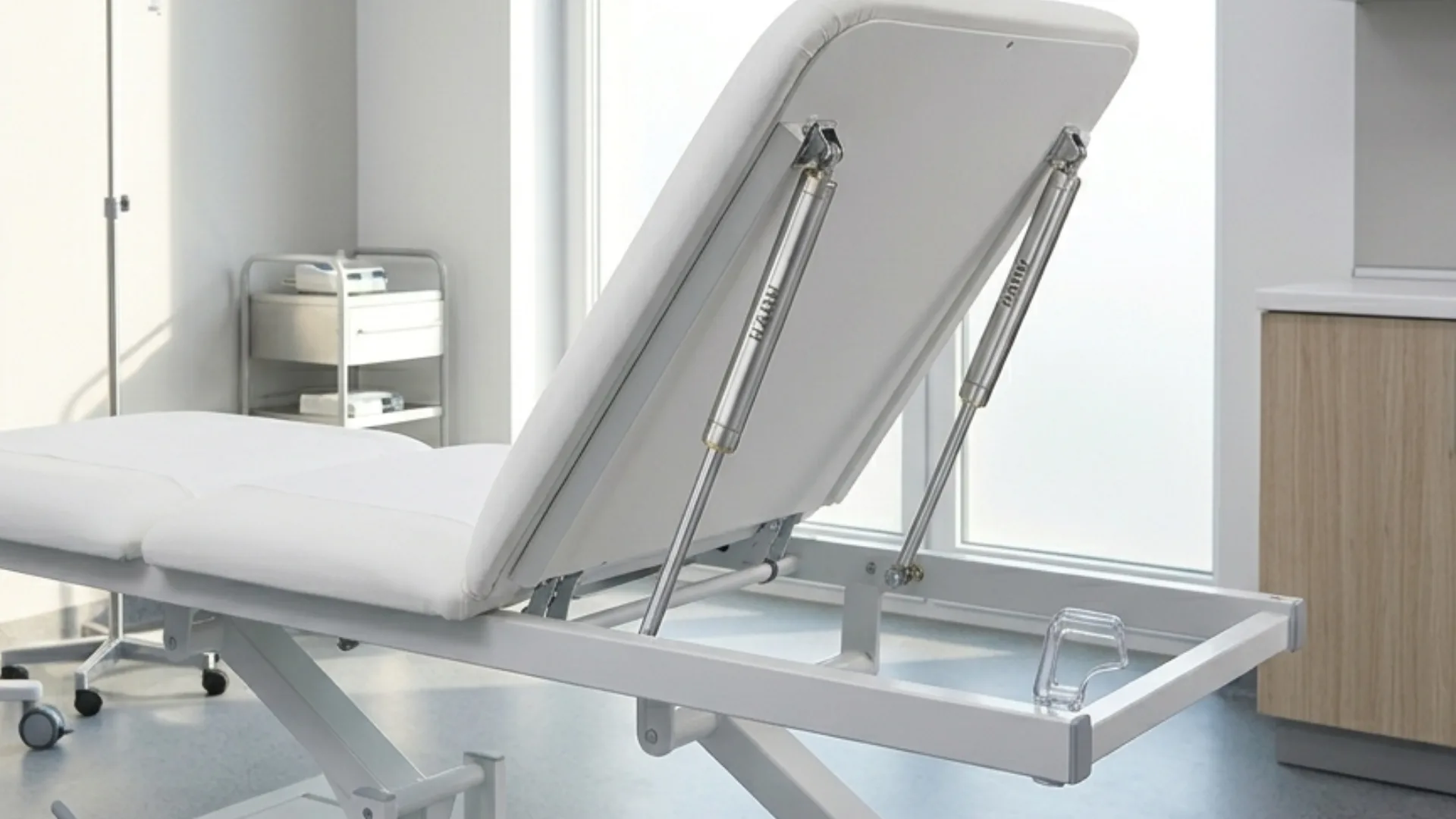
Gas struts are primarily compression-type devices. They resist being pushed in and extend back out once released. You’ll find them in car boot lids, industrial hatches, heavy machine covers, and medical equipment lids across a wide range of industries.
Key characteristics of gas struts:
- Fixed or adjustable force ratings (measured in Newtons)
- Consistent force output across the stroke length
- Available in lockable and non-lockable variants
- Operating temperature ranges from -40°C to +80°C depending on specification
Types of Gas Lift Supports and Their Applications
Gas lift support are a subtype of gas struts specifically engineered for lifting and holding applications. While all gas lift supports are gas struts by nature, not all gas struts function as lift supports. The distinction lies in the application intent and the force profile required.
Gas lift support are optimised for:
- Counterbalancing the weight of a lid, door, or panel so it stays open without effort
- Providing a smooth, controlled opening motion especially important in furniture and ergonomic equipment
- Holding a component at mid-position common in adjustable workstations or sit-stand desks
Common Applications in Malaysia
In Malaysia’s manufacturing and interior design landscape, gas lift support appear frequently in:
- Kitchen cabinet lift systems top-hinged cabinet doors in modern residences and hotel projects
- Office furniture height-adjustable monitor arms and sit-stand converters
- Hospital and clinic equipment examination table lids and medical cart covers
- Automotive components bonnet supports for heavier commercial vehicle hoods
The primary functional difference is that gas lift supports are usually calibrated to match a specific load weight, ensuring the supported panel stays open at a defined angle without drifting closed or flying open. If you’re sourcing for industrial projects, the Hahn Gasfedern product line from Eumation covers an extensive range of both standard and application-specific gas spring variants.
Gas Lift Supports vs Gas Struts: Key Differences
Understanding the technical distinctions helps avoid costly misapplication. Here’s a structured comparison:
1. Force Profile and Load Matching
Standard gas struts are available across a broad Newton range and are selected based on the mechanical geometry of the application. Gas lift support, on the other hand, are often pre-engineered to counterbalance a specific weight within a defined angle range. The force-to-weight ratio is more tightly specified.
2. End Position Behaviour
Gas struts used as simple counterweights may not hold a lid at a precise angle. Gas lift support are typically designed to hold the load in the fully open position, making them preferred in furniture and cabinetry where hands-free operation is expected.
3. Stroke Length and Mounting Geometry
Both types require careful stroke and mounting calculation, but gas lift supports often have shorter strokes with higher force outputs relative to their body length, as they are mounted close to the hinge axis of the panel they support.
4. Locking Capability
Some gas struts particularly in industrial and automotive applications include a locking function that fixes the rod at any position along the stroke. Standard gas lift support for furniture typically do not have this feature, as free-floating counterbalancing is sufficient.
5. Durability and Cycle Life
Industrial gas struts used in heavy machinery are built for hundreds of thousands of cycles under demanding conditions. Gas lift supports for residential furniture may be rated for lower cycle counts but are optimised for smooth, quiet operation that suits living and working environments.
How to Choose the Right Gas Lift Supports
Selecting between gas lift support and gas struts comes down to four critical factors:
- Load Weight Calculate the exact weight of the panel or component being supported. This determines the required force rating in Newtons.
- Mounting Geometry The distance from the hinge point to the gas strut mounting position on both the panel and the frame affects the effective force. Even a small change in mounting position significantly changes the required strut specification.
- Operating Angle Determine the full range of movement from fully closed to fully open. Gas lift support must be selected to ensure they hold the panel open at the desired angle without bottoming out or over-extending.
- Environmental Conditions In Malaysian conditions, particularly in outdoor or coastal industrial environments, corrosion resistance matters. Stainless steel cylinders and chrome-plated rods are recommended for humid or marine environments.
For complex or multi-axis applications, working directly with a specialist supplier to run a proper selection calculation is strongly recommended. Eumation’s team can assist with selection support for Hahn Gasfedern gas spring systems, ensuring you get the right specification from the start.
Gas Lift Supports in Malaysian Industries
Malaysia’s diverse industrial base offers a clear picture of how both gas struts and gas lift supports are deployed in practice.
- Furniture Manufacturing (Selangor & Johor) Many local OEM furniture manufacturers producing for export markets specify gas lift supports for top-hinged cabinet systems. Soft-close and lift-and-hold behaviour is a standard expectation for European and Middle Eastern buyers. Incorrect force ratings are one of the most common causes of warranty returns in this segment.
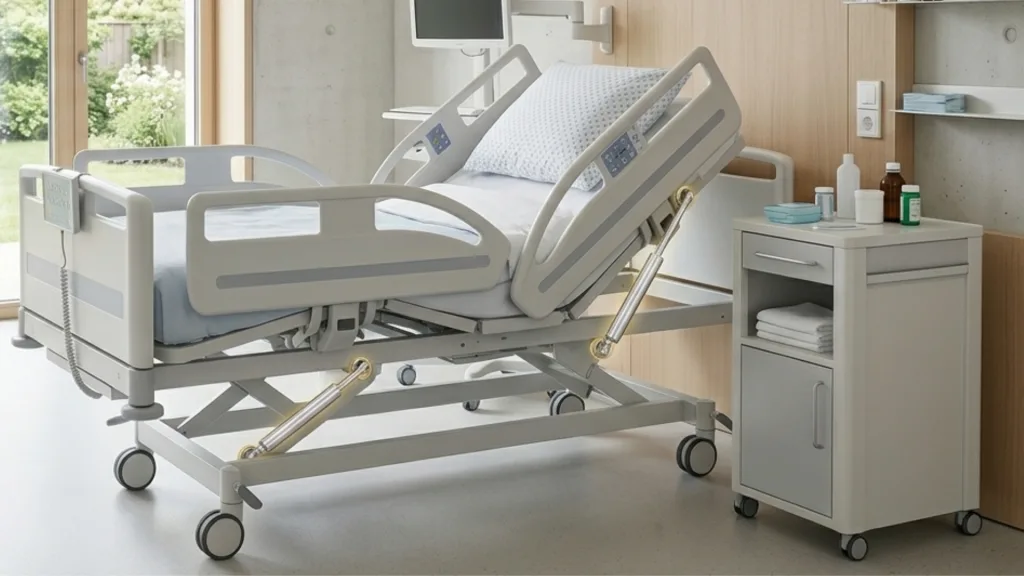
- Medical Equipment Locally assembled hospital beds and examination couches frequently use gas struts for backrest and leg section adjustment. These require lockable variants with precise force control, as patient safety depends on the mechanism holding firmly under load.
- Automotive Assembly Malaysian automotive component suppliers use gas struts extensively for bonnet and boot assemblies. The specifications here are tightly controlled by OEM standards, requiring certified and traceable components.
- Industrial Machinery Machine covers, access panels, and equipment lids on CNC machines and production line equipment throughout Malaysia’s industrial corridors in Shah Alam, Penang, and Johor Bahru rely on heavy-duty gas struts rated for high-cycle use in demanding factory environments.
Conclusion
Gas lift supports and gas struts are related but distinct motion control solutions. Gas struts are the broader product category, engineered to provide controlled force over a defined stroke. Gas lift supports are a more application-specific variant, calibrated to counterbalance panel weight and maintain a stable open position a critical requirement in furniture, medical equipment, and ergonomic systems.
The difference in specification, force profile, and mounting geometry between the two means that selecting the correct type is not simply a matter of preference it directly affects the functionality, safety, and longevity of the final product.
For businesses and engineers in Malaysia seeking reliable, technically certified gas spring solutions, working with an established distributor ensures access to proper product selection support, compliance documentation, and consistent supply. Explore the full Hahn Gasfedern gas spring catalogue at Eumation to find the right solution for your application, or visit Eumation’s full product and service portfolio for a broader range of industrial components. If you’re ready to discuss your specific requirements, the team’s engineering services can provide technical guidance and sourcing support tailored to your project.