

Modern furniture is no longer just about aesthetics it’s about how it moves, responds, and adapts to human behaviour. Behind the smooth lift of a kitchen cabinet door, the effortless rise of a Murphy bed, or the controlled recline of a premium office chair lies a small but critical component: the furniture gas spring.
For designers, manufacturers, and procurement professionals in Malaysia, specifying the right motion control component is increasingly a defining factor in product quality and market competitiveness. As local OEM furniture makers scale up exports to Europe, the Middle East, and beyond, the performance standard expected from every moving part has risen sharply.
This article explores the key applications of furniture gas springs across modern furniture categories, explains why they outperform traditional hinges and mechanical counterweights, and helps you understand what to look for when sourcing for Malaysian projects. For a trusted range of gas spring products, the Hahn Gasfedern collection at Eumation is a strong starting point.
What Is a Furniture Gas Spring?
A furniture gas spring is a sealed mechanical device that uses compressed nitrogen gas to generate a controlled, consistent pushing force. As the piston rod is compressed into the cylinder, pressure builds; when released, that stored energy extends the rod smoothly back to its original position.
Unlike conventional coil springs, which deliver uneven force across their travel range, gas springs provide near-linear force output throughout the entire stroke. This makes them especially well-suited to furniture applications where smooth, predictable movement is essential whether opening a hinged lid, lifting a fold-down desk, or supporting an adjustable monitor arm.
Key components of a furniture gas spring include:
- Nitrogen-filled cylinder the pressure chamber that drives the force output
- Chrome-plated piston rod the moving element that transfers force to the furniture component
- Precision seal system maintains gas pressure and prevents leakage over thousands of cycles
- End fittings ball joints, clevis brackets, or threaded connectors that mount the spring to the furniture frame and moving panel
The force rating, measured in Newtons, is matched to the weight and geometry of the furniture panel being supported. Get the specification right and the result is a lid that holds open effortlessly, closes softly, and lasts for years without adjustment.
Key Applications of Furniture Gas Springs
The versatility of the furniture gas spring has made it a standard component across a wide range of furniture categories. Here are the most common and impactful applications:
Kitchen Cabinet Lift Systems
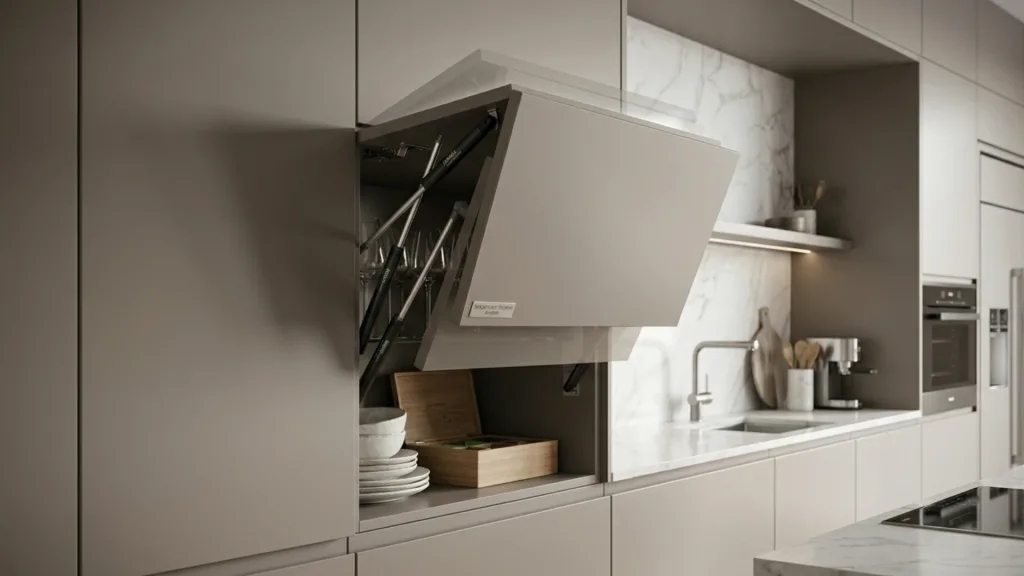
Top-hinged kitchen cabinet doors particularly in modern handleless kitchen designs rely on gas springs to counterbalance the weight of the door panel. Without the correct force rating, a cabinet door either slams shut under its own weight or requires excessive effort to open.
In Malaysian kitchen manufacturing, particularly among suppliers producing for residential developers and hotel fit-out projects, lift systems with integrated furniture gas springs are now a baseline specification rather than a premium option. Common configurations include:
- Single-arm lift fittings for lightweight upper cabinet doors
- Parallel arm systems for heavier, full-height panels
- Flap-stay fittings for horizontal drop-down doors
Bed Lift and Storage Systems
Murphy beds, ottoman storage beds, and divan lift mechanisms all depend on gas springs to make heavy mattress platforms manageable. A correctly specified furniture gas spring counterbalances the mattress and base weight so that a single person can raise or lower the platform with minimal effort.
This application is growing rapidly in Malaysia as smaller urban apartments in Kuala Lumpur and the Klang Valley drive demand for multi-functional furniture. Space-saving beds with integrated storage are increasingly specified by interior designers working on service apartments and compact condominiums.
Office and Ergonomic Furniture
Height-adjustable components, monitor arms, laptop stands, and ergonomic chair mechanisms all incorporate gas springs in various configurations. In office chairs, a lockable gas spring in the central column allows seat height adjustment with a simple lever action a mechanism most users interact with daily without giving it a second thought.
For the Hahn Gasfedern gas spring range, which includes both standard and lockable variants, this category represents one of the highest-volume application areas. Malaysian office furniture manufacturers supplying government tenders and corporate fit-outs increasingly require documented cycle-life ratings and load certifications for these components.
Hinged Access Panels and Lids
Storage ottomans, chest lids, toy boxes, and blanket boxes all benefit from gas springs that slow the closing motion and hold the lid open at a safe angle. This is particularly important in furniture intended for children’s rooms, where a sudden-closing lid poses a safety risk.
Soft-close behaviour where the gas spring decelerates the lid in the final portion of its travel is achievable through damped gas spring variants. These are specified when a premium, refined feel is required in the finished product.
Recliners and Adjustable Sofas
Premium recliner mechanisms increasingly use gas springs alongside or in place of traditional mechanical levers and coil spring assemblies. The result is a smoother, quieter reclining action with more precise position control. Some high-end designs use lockable furniture gas springs that allow the backrest to be fixed at any angle along the reclining range a feature valued in media rooms and home theatre seating.
Gas Springs vs Traditional Alternatives
Before gas springs became widely accessible, furniture designers relied on coil springs, torsion bars, friction hinges, and mechanical counterweights to manage panel movement. Each has limitations that gas springs address directly.
Coil springs deliver inconsistent force stiffer at full compression, weaker at extension making smooth, controlled movement difficult to achieve. They also fatigue over time, losing force and requiring replacement.
Friction hinges rely on mechanical resistance rather than counterbalancing, meaning the effort required to move a panel changes with wear. They also offer no hold-open function.
Mechanical counterweights add bulk and weight to furniture, conflicting with the trend toward lightweight, space-efficient design.
Furniture gas springs solve all three problems: consistent force output across the stroke, no mechanical wear at the friction point, and compact form factor. They also operate silently, which is an important consideration in residential and hospitality furniture.
How to Choose the Right Furniture Gas Spring
Choosing the correct gas spring requires more than picking a force rating off a catalogue. Several factors interact to determine whether a spring performs correctly in a given application:
- Panel Weight The total weight of the moving component including any hardware, glass inserts, or decorative elements determines the baseline force requirement.
- Mounting Geometry The distance from the hinge axis to the gas spring mounting point on both the panel and the frame directly affects the mechanical advantage available. Small changes in mounting position can require significantly different force ratings.
- Stroke Length The spring must have sufficient stroke to travel through the full opening angle of the panel without bottoming out or over-extending. Stroke calculation requires knowledge of the mounting geometry and the desired opening angle.
- Operating Environment For kitchen applications where humidity and heat are factors, corrosion-resistant cylinder coatings or stainless steel construction may be required. For outdoor furniture, UV-resistant seals and marine-grade materials are appropriate.
- Cycle Life Residential furniture applications typically require 20,000 to 50,000 cycles. Commercial or hospitality furniture hotel room wardrobes, restaurant banquette storage — may require 100,000 cycles or more.
Working with a specialist supplier who can support your selection calculation is strongly recommended, especially for new product development. Eumation’s team provides technical sourcing and engineering support for furniture manufacturers specifying gas springs across a wide range of applications.
Furniture Gas Springs in Malaysia
Malaysia is one of Southeast Asia’s largest furniture exporters, with a significant concentration of manufacturers in Muar (Johor), Klang Valley, and Penang. As export markets particularly Europe and the United States raise their quality and safety standards, the components that go into Malaysian-made furniture are under closer scrutiny than ever.
Furniture gas springs sourced from certified European manufacturers carry documented performance data, material compliance certifications (RoHS, REACH), and traceable quality records. For export-oriented manufacturers, this documentation is increasingly a prerequisite for buyer approval rather than a bonus.
Beyond compliance, the performance difference between a premium and a budget gas spring is noticeable to the end user. A cabinet that opens smoothly and holds firmly reflects well on the furniture brand. One that droops, slams, or fails prematurely undermines customer confidence regardless of how well the rest of the piece is made.
For Malaysian furniture businesses looking to elevate their product quality and meet international buyer expectations, specifying the right gas spring from a reliable source is one of the highest-impact decisions in the component selection process.
Conclusion
The furniture gas spring may be one of the smallest components in a piece of furniture, but its impact on the user experience is outsized. From kitchen cabinet lift systems to ergonomic office chairs, bed storage mechanisms to premium recliners, gas springs define how furniture moves and how that movement feels.
For designers and manufacturers in Malaysia, selecting the right gas spring is both a quality decision and a commercial one. The right specification means a product that performs reliably, meets international standards, and builds the kind of brand reputation that sustains long-term buyer relationships.
Explore the full range of certified furniture gas spring solutions through the Hahn Gasfedern catalogue at Eumation, or visit Eumation’s website to learn more about their industrial component offerings. Ready to discuss your specific application? Reach out through Eumation’s contact page or explore their engineering and sourcing services for tailored technical support.