
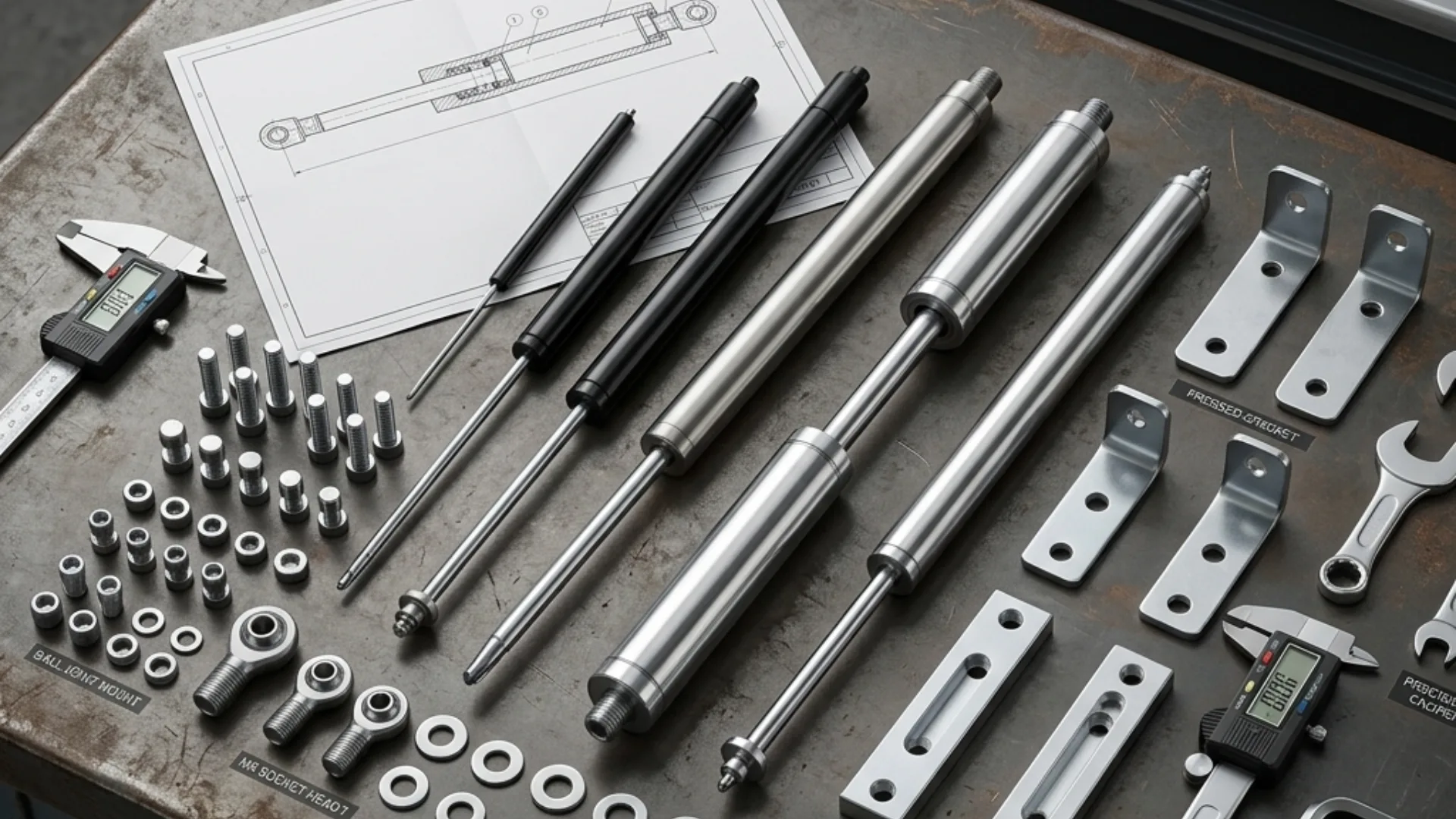
From the smooth recline of an office chair to the effortless lift of a car boot, hydraulic gas springs are quietly at work in dozens of everyday applications yet most people have never heard the term. In engineering and design circles, however, these compact devices are considered essential. They offer controlled, reliable motion without the noise and complexity of mechanical spring systems.
For manufacturers, furniture designers, and industrial engineers in Malaysia, sourcing the right motion control component can significantly impact product quality and end-user experience. Whether you’re building medical equipment, automotive accessories, or ergonomic office furniture, understanding how a hydraulic gas spring functions will help you make smarter design decisions. In this article, we’ll break down the mechanics, explore real-world applications, and explain what makes these components so valuable in modern manufacturing. If you’re looking to source quality gas springs in Malaysia, explore the full range available at Hahn Gasfedern gas spring solutions on Eumation.
What Makes a Hydraulic Gas Spring Different
A hydraulic gas spring sometimes referred to simply as a gas strut or gas lift is a type of mechanical actuator that uses compressed gas (typically nitrogen) and hydraulic fluid to generate a controlled, consistent pushing or damping force. Unlike traditional coil springs, which rely purely on metal tension, these devices combine two physical principles: gas compression and fluid resistance.
This dual mechanism gives the hydraulic gas spring a significant advantage: it can be engineered to exert precise force across a defined stroke length, making it predictable and repeatable. That level of control is essential in applications where safety, user comfort, and product longevity are priorities.
The Basic Anatomy
A standard hydraulic gas spring consists of the following core components:
- Outer tube (cylinder): The sealed housing that contains the working media
- Piston rod: The moving component that extends or retracts under load
- Piston: Separates the gas and fluid chambers; fitted with seals to prevent leakage
- Nitrogen gas: Stored under high pressure (typically between 100 and 200 bar) to generate the extension force
- Hydraulic oil: Fills the lower chamber and passes through an orifice in the piston to control the speed of movement
- End fittings: Mounting interfaces (eyes, balls, or threaded ends) that connect the spring to the application
The hydraulic fluid doesn’t generate force it regulates movement speed. This is the critical distinction between a pure gas spring and a hydraulic gas spring. The oil-dampened version is far better suited for applications where a sudden, uncontrolled release of force would be unsafe or disruptive.
Why a Hydraulic Gas Spring Moves Smoothly
To understand the working principle, imagine pushing down on the piston rod. As you compress the spring, the gas in the sealed cylinder is forced into a smaller volume. By Boyle’s Law, pressure increases as volume decreases. When you release the rod, this stored pressure pushes back extending the rod outward.
Here’s where the hydraulic element comes in. The piston inside the cylinder has a small orifice (or multiple orifices) through which hydraulic oil flows as the rod moves. The resistance created by the oil passing through this restriction acts as a damper, slowing the movement to a controlled rate. Without this damping, the rod would snap back violently.
Key Operating Characteristics
- Extension force: The outward push generated when the spring is compressed; determined by gas pressure and piston area
- Stroke length: The total distance the piston rod travels between fully compressed and fully extended positions
- Damping rate: The speed at which the spring extends or compresses; controlled by the orifice size in the piston
- End position damping: Some hydraulic gas springs include a cushioned deceleration near the end of the stroke, preventing hard impacts
These characteristics are configurable. Manufacturers like Hahn Gasfedern engineer their gas springs to precise specifications, allowing designers to dial in the exact force and speed characteristics their application requires.

Hydraulic Gas Spring Uses Across Industries
The versatility of this component is one of its greatest strengths. Industries across Malaysia and Southeast Asia rely on hydraulic gas springs for a wide range of applications from light consumer goods to heavy industrial machinery.
Furniture and Interior Design
In Malaysia’s fast-growing furniture manufacturing sector particularly in Johor Bahru and Klang Valley hydraulic gas springs are widely used in:
- Office chairs: Seat height adjustment mechanisms
- Recliners and sofa beds: Smooth folding and unfolding motion
- Wall beds (Murphy beds): Counterbalancing the mattress weight for easy one-handed operation
- Lift-top coffee tables: Ergonomic surface adjustment with no visible mechanism
Automotive and Transportation
Gas springs are found in almost every modern vehicle:
- Boot lids and tailgates: Holding the lid open at any angle
- Bonnets: Providing counterbalance during engine access
- Seat adjustments and headrests: Controlling movement range and speed
- Truck canopies and commercial vehicle storage: Supporting heavy panels
Medical and Laboratory Equipment
In healthcare environments, reliability and precise control are non-negotiable:
- Hospital bed height adjustment: Smooth, quiet operation for patient comfort
- Dental chairs and examination tables: Controlled recline and positioning
- Diagnostic equipment enclosures: Safe, controlled opening of instrument panels
- Clean room cabinets: Preventing sudden movements that could disturb sensitive environments
Industrial Machinery and Tooling
Industrial applications often demand heavy-duty variants:
- Machine access panels and guards: Holding covers safely open during maintenance
- Moulding and pressing equipment: Controlled die opening sequences
- Agricultural equipment: Bonnet and panel support on tractors and machinery
For a curated selection of industrial and commercial-grade options, the Hahn Gasfedern product range at Eumation offers certified solutions that meet European quality standards.
Choosing a Hydraulic Gas Spring for Your Project
Choosing the correct hydraulic gas spring for your application isn’t just a matter of picking the right size. Several engineering parameters must be evaluated carefully to ensure long-term performance and safety.
1. Force Calculation
The extension force required depends on the weight of the component being supported and its centre of gravity relative to the mounting points. For a lid or panel, this typically involves calculating torque and distributing it across the number of springs used. Most reputable suppliers provide force calculation tools or technical support.
2. Stroke and Mounting Distance
The stroke length must allow the component to move through its full range of travel. Mounting distances both the compressed length and the extended length must fit within the available space in the application.
3. Temperature Range
Malaysia’s tropical climate presents its own engineering challenges. Standard gas springs perform well between -20°C and +80°C, but for applications near heat sources or in outdoor environments, high-temperature variants should be specified. The gas pressure inside the cylinder is temperature-dependent, so ambient conditions affect output force.
4. End Fittings and Orientation
The way a gas spring is mounted affects both its function and its longevity. Most manufacturers recommend mounting the rod end downward (rod-down orientation) to ensure the oil continuously lubricates the seals. Mounting in rod-up orientation is possible but typically requires a specially modified design.
5. Cycle Life and Load Rating
Industrial applications may subject gas springs to tens of thousands of cycles per year. It’s essential to match the product’s rated cycle life to the application’s expected demand. Premium brands engineer their products to exceed 50,000 cycles without significant performance degradation.
Hydraulic Gas Spring vs Standard Gas Spring
This is a question that arises frequently when engineers first specify motion control components. Here’s a concise comparison:
| Feature | Standard Gas Spring | Hydraulic Gas Spring |
|---|---|---|
| Working medium | Nitrogen gas only | Nitrogen gas + hydraulic oil |
| Speed control | Minimal rod extends quickly | Adjustable rod extends at a controlled pace |
| Damping | Little to none | Integrated, consistent damping |
| Typical applications | Light-duty lids, hatches | Furniture, automotive, medical, industrial |
| Cost | Lower | Slightly higher due to complexity |
| Safety in fast-opening applications | Limited | High prevents sudden, uncontrolled movement |
For applications where user safety and smooth operation are priorities which covers the vast majority of commercial and industrial uses a hydraulic gas spring is the recommended choice. The added complexity translates directly into superior real-world performance.
If you’re still comparing options or need technical guidance on which specification suits your project, get in touch with the Eumation team for expert support.
Conclusion
The hydraulic gas spring may be a small component, but its engineering impact is substantial. By combining pressurised nitrogen with oil-based damping, it delivers something that mechanical springs simply cannot: smooth, controlled, repeatable motion that can be tailored precisely to the demands of any application. From ergonomic office furniture in Kuala Lumpur to precision medical equipment and heavy industrial machinery, these components underpin the quality and safety of countless products across Malaysia and beyond.
As a designer or engineer, understanding how hydraulic gas springs work and how to specify them correctly gives you a meaningful advantage in creating products that feel refined and perform reliably over time. The right gas spring doesn’t just hold something open; it defines the quality impression your product makes on every user, every single time.
Ready to explore your options? Browse the full range of certified gas springs and motion control solutions at Hahn Gasfedern on Eumation, or reach out directly to discuss your project requirements through the Eumation contact page. The right component, correctly specified, makes all the difference.