
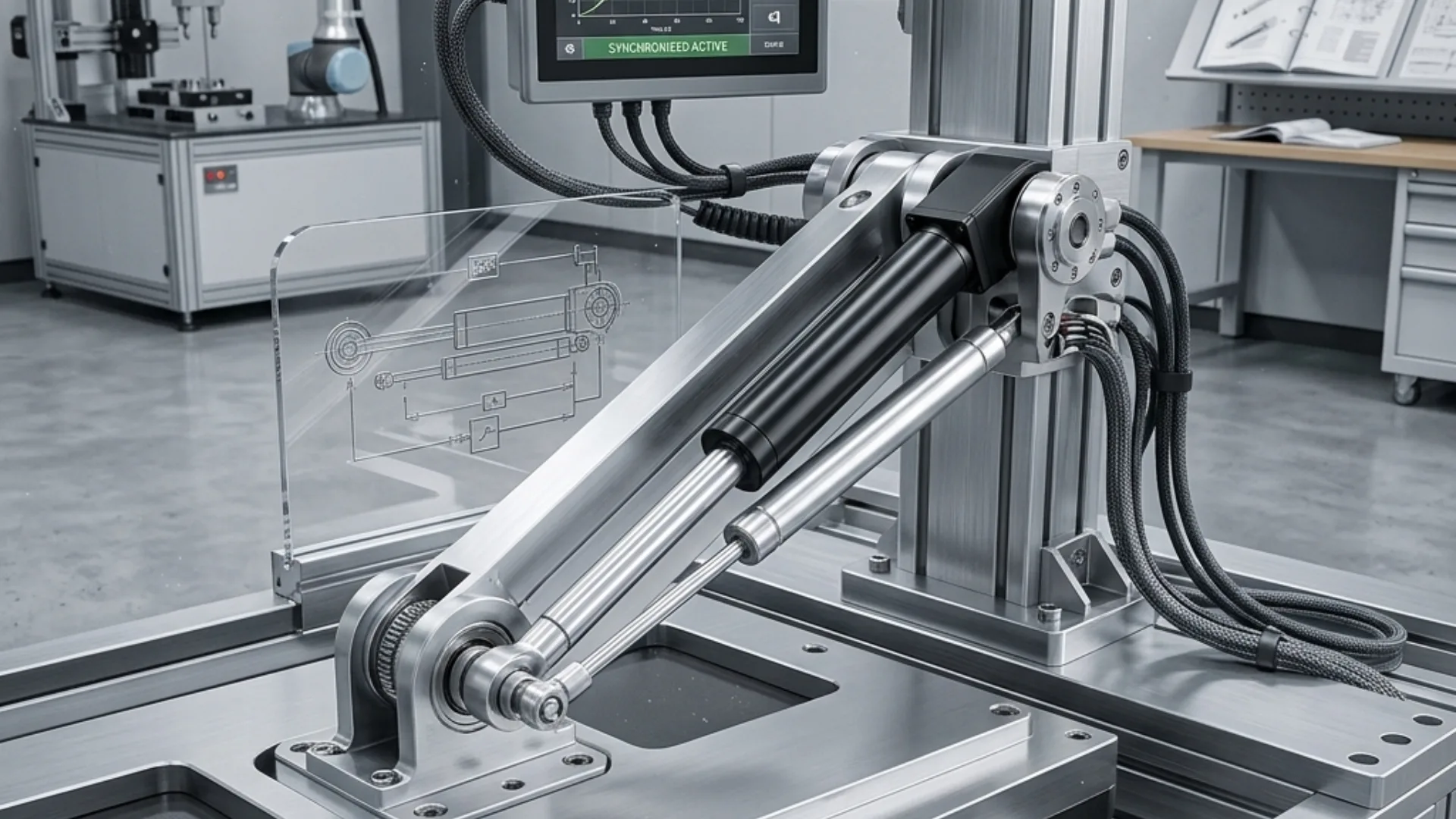
Industrial machinery is the backbone of modern production. From the automotive assembly lines in Perak to the semiconductor fabrication plants in Penang, Malaysia’s manufacturing sector depends on a vast ecosystem of machines that cut, press, lift, seal, move, and control with a precision no human hand can replicate at scale. Yet for all its importance, “industrial machinery” remains a term that many business owners and procurement managers use loosely without fully understanding the categories involved, how different machines operate, or how choosing the right mechanical components affects performance and safety.
This guide unpacks industrial machinery from the ground up: what it is, how it is classified, the engineering principles behind it, the business benefits it delivers, and the critical role that precision components play in keeping it all running reliably. One example worth noting early on is the use of gas springs in industrial equipment by Hahn Gasfedern a component that illustrates just how much engineering intelligence can be packed into a single part.
What Is Industrial Machinery? A Clear Definition
The term “industrial machinery” covers any mechanical system used in the production, processing, or handling of goods at a commercial or industrial scale. It is a broad category deliberately so because modern manufacturing spans dozens of industries, each with its own specialised equipment requirements.
At its core, industrial machinery converts energy (electrical, pneumatic, hydraulic, or mechanical) into controlled motion or force that performs a specific task. A hydraulic press converts fluid pressure into compressive force. A conveyor system converts electrical energy into linear movement. A CNC milling machine converts programmed instructions and rotational energy into precise material removal.
What distinguishes industrial machinery from general commercial equipment is the combination of:
- Scale and output capacity designed to operate continuously, often 24/7, at production volumes impossible to achieve manually
- Precision and repeatability able to perform the same operation thousands of times with minimal variation
- Durability and serviceability built for long service lives in demanding environments, with components that can be maintained or replaced
- Safety engineering incorporating guards, interlocks, emergency stops, and controlled-force mechanisms to protect operators
Understanding this definition matters because it shapes how you specify, purchase, and maintain equipment and which components you choose to integrate into the system.
Major Types of Industrial Machinery & Their Uses
Industrial machinery does not fit neatly into one box. The category spans several distinct types, each with its own operating principles and industry applications. Knowing these categories helps procurement teams and engineers make better-informed decisions.
Processing and Manufacturing Machinery
This is the largest category, covering machines that directly transform raw materials into finished or semi-finished goods.
- CNC machining centres used in aerospace, automotive, and electronics manufacturing to cut, drill, and mill metal and composite materials with computer-controlled precision
- Injection moulding machines the backbone of Malaysia’s plastics industry, converting polymer pellets into complex shaped components under heat and pressure
- Industrial presses stamping, forging, and forming presses that shape sheet metal into structural parts for vehicles, appliances, and construction
- Extrusion machines used to produce profiles, pipes, and rods by forcing heated material through a shaped die
Material Handling and Logistics Machinery
These machines move products and materials through a facility rather than transforming them.
- Industrial conveyors belt, roller, and chain conveyors that transport goods between workstations or through processing lines
- Overhead cranes and hoists used in heavy manufacturing, shipyards, and steel plants across Malaysia’s industrial zones in Shah Alam and Port Klang
- Automated guided vehicles (AGVs) increasingly used in e-commerce fulfilment centres and automotive plants to move pallets and components without human operators
- Forklift trucks and reach stackers essential in warehouse and logistics operations, particularly at Westports and Northport in Klang
Assembly and Joining Machinery
This category covers machines that bring multiple components together into a finished assembly.
- Industrial robots multi-axis robotic arms used in welding, painting, pick-and-place, and assembly operations in electronics and automotive plants
- Welding machines MIG, TIG, and laser welding systems that join metal components with high strength and consistency
- Riveting and fastening machines used in aerospace and structural fabrication to apply mechanical fasteners at speed and with controlled force
Inspection and Testing Machinery
Quality control machinery verifies that manufactured goods meet specifications before leaving the facility.
- Coordinate measuring machines (CMMs) high-precision instruments that verify the dimensions of machined parts against CAD tolerances
- Vision inspection systems camera-based systems that detect surface defects, label placement errors, and assembly faults on fast-moving production lines
- Non-destructive testing (NDT) equipment ultrasonic, X-ray, and magnetic particle systems that detect internal flaws without damaging the part
How Industrial Machinery Works: Core Principles
Understanding how industrial machinery functions at a mechanical level helps engineers specify the right equipment and identify failure modes before they cause downtime.
Force, Motion, and Energy Conversion
Every machine performs one or more of three fundamental operations: it generates force, creates motion, or converts energy from one form to another. A hydraulic cylinder generates linear force from fluid pressure. A gearbox converts rotational speed and torque. A pneumatic actuator uses compressed air to create linear or rotary motion.
The quality and reliability of these functions depend heavily on the precision components integrated into the machine. This is where seemingly simple parts like gas springs play an outsized role in overall system performance.
The Role of Gas Springs in Industrial Machinery
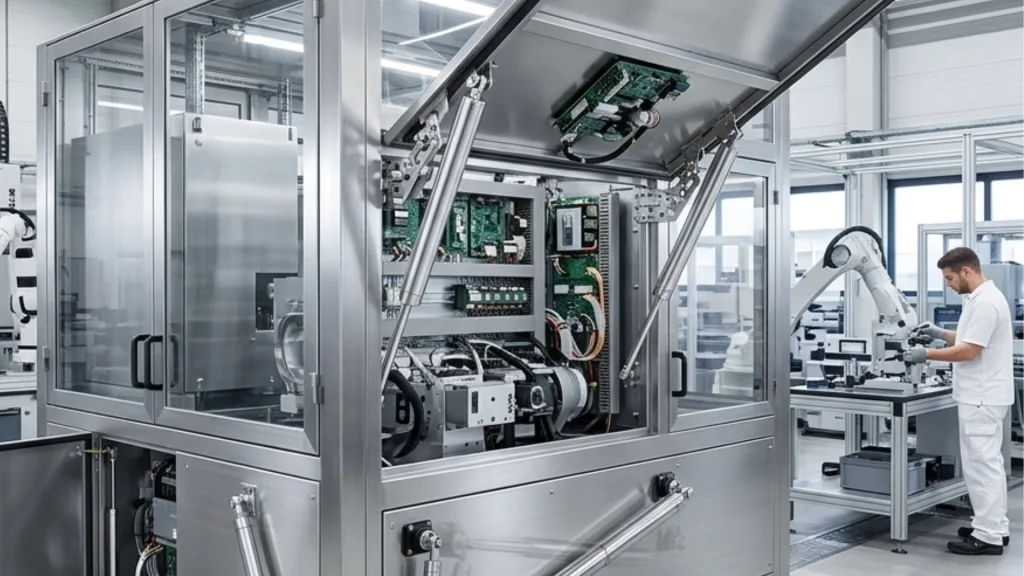
Gas springs are sealed cylinders containing compressed nitrogen gas that exert a controlled, progressive force over a defined stroke length. In industrial machinery, they serve several critical functions that are easy to underestimate until they fail:
- Counterbalancing offsetting the weight of heavy machine lids, guards, access panels, and tool holders so they stay open safely without hydraulic or electrical assistance
- Return force providing the restoring force that returns a press tool, jig, or fixture to its starting position after each cycle
- Vibration damping absorbing shock and oscillation in stamping and forming operations to protect precision components
- Controlled closing ensuring that machine covers and doors close at a controlled, safe speed rather than slamming shut
Hahn Gasfedern gas springs available through Eumation in Malaysia are engineered specifically for industrial machine integration, with specifications covering force ranges, stroke lengths, and temperature ratings suited to demanding production environments. Selecting the correct gas spring specification for a given application is not a minor detail; it directly affects operator safety, cycle time, and component longevity.
Control Systems and Automation
Modern industrial machinery integrates mechanical systems with electronic control PLCs (programmable logic controllers), HMIs (human-machine interfaces), servo drives, and increasingly, industrial IoT sensors that monitor machine condition in real time. This convergence of mechanical and electronic engineering is what enables the precise, repeatable performance that modern manufacturing demands.
Key Benefits of Industrial Machinery in Malaysia
The case for investing in the right industrial machinery goes well beyond simple productivity gains. For Malaysian manufacturers competing in export markets and navigating rising labour costs, machinery investment is increasingly a strategic imperative.
Productivity and Output Consistency
Industrial machines can operate at speeds and volumes that make manual production economically unviable at scale. A single injection moulding machine can produce thousands of identical components per shift, with cycle times measured in seconds. A robotic welding cell can complete a join in a fraction of the time a manual welder takes and do so with perfectly consistent bead quality across every single part.
For Malaysia’s export-oriented manufacturers in electrical and electronic products, rubber goods, palm oil processing equipment, and precision-engineered components this consistency is what allows them to meet international buyer specifications reliably.
Worker Safety and Ergonomic Protection
One of the most underappreciated benefits of well-designed industrial machinery is the protection it extends to workers. Machines equipped with proper safety components:
- Reduce manual handling injuries conveyors and lift assists eliminate heavy lifting that causes musculoskeletal damage over time
- Control hazardous forces properly specified gas springs ensure that heavy machine covers cannot drop suddenly on an operator’s hands or head
- Isolate workers from hazardous processes robotic cells handle welding, spray painting, and chemical dosing in enclosed, ventilated environments
Malaysia’s Department of Occupational Safety and Health (DOSH) mandates specific machinery safety standards, and investing in compliant, well-engineered equipment is both a legal and ethical obligation for employers.
Energy Efficiency and Operational Cost Reduction
Older industrial machinery is often a significant source of energy waste. Upgrading to modern, energy-efficient equipment with variable-frequency drives, regenerative systems, and precision components that reduce friction and parasitic losses can meaningfully reduce electricity consumption.
In Malaysia, where industrial electricity tariffs under TNB’s medium-voltage pricing can be substantial for large manufacturers, even a 10–15% reduction in machine energy consumption translates to real cost savings over a 5–10 year equipment lifecycle.
Scalability and Future-Readiness
Well-specified industrial machinery is designed to be upgraded and integrated as production demands evolve. Modular designs, standard interfaces, and compatible component ecosystems mean that a manufacturer can expand capacity, add automation, or integrate new control systems without replacing the entire machine.
This scalability is particularly relevant for Malaysian SME manufacturers looking to move up the value chain from labour-intensive assembly to higher-precision, higher-margin production.
Conclusion
Industrial machinery is not a single product category it is an ecosystem of interconnected mechanical systems, each dependent on the quality of its components, the precision of its engineering, and the expertise of the people who specify and maintain it. For Malaysian manufacturers navigating a competitive global market, understanding this ecosystem is not an academic exercise. It is a practical necessity.
From the major categories of processing, handling, assembly, and inspection machinery, to the engineering principles that govern how machines generate force and motion, to the individual components like gas springs that ensure safety, reliability, and controlled performance, every level of the system deserves deliberate attention.
If your operation relies on industrial machinery and you’re reviewing the precision components that keep your equipment running safely and efficiently, explore the Hahn Gasfedern gas spring range at eumation.com or visit eumation.com to discover the broader range of industrial solutions available to Malaysian manufacturers.