

Gas struts are mechanical devices found in countless applications from car hoods to industrial machinery and medical equipment. Understanding how gas struts function provides insight into the hydraulic and pneumatic technology that powers modern conveniences.
A gas strut solves a fundamental engineering problem: how to control motion and support weight smoothly without complicated mechanical systems. Rather than relying on traditional springs or pulleys, gas struts use compressed gas and hydraulic fluid to provide both force and damping in a single package.
Whether you’re an engineer specifying components, a facility manager maintaining equipment, or simply curious about everyday technology, understanding gas struts is increasingly important. In Malaysia’s growing manufacturing sector, knowledge of these components supports better equipment selection and maintenance. This guide explores mechanical principles, practical applications, and performance characteristics that make gas struts indispensable across industries. For comprehensive information on professional-grade gas springs solutions, explore our complete gas springs product range.
Inside a Gas Strut: Key Components
Gas struts consist of simple components arranged in a precisely engineered system. Understanding the basic architecture explains how these devices deliver consistent performance across demanding applications.
Primary Internal Components:
Every gas strut contains four essential elements:
- Cylinder: Seamless steel tube housing the internal mechanism and pressurized gas
- Rod: Precisely machined piston rod connected to the load
- Piston: Flat shape separating pressurized gas from hydraulic fluid
- Hydraulic Fluid: Mineral oil providing damping and force transmission
The cylinder walls withstand enormous internal pressure (50-300 bar). Manufacturing precision is critical; imperfections compromise performance or reduce lifespan.
Pressure and Sealing Systems:
Compressed nitrogen occupies the upper chamber above the piston. Below sits hydraulic fluid providing damping action. High-quality elastomer seals prevent gas leakage while allowing smooth rod motion. Manufacturing tolerances are remarkably tight measured in micrometers.
The Rod and Piston Assembly:
The rod extends and retracts through a precision bushing guiding motion. As the rod moves, the piston changes relative volumes of gas and hydraulic fluid, creating controlled force response. Different piston designs serve different purposes.
How Gas Struts Generate Force
The fundamental principle underlying gas struts operates according to gas laws the relationship between pressure, volume, and force that enables these devices to support weight and resist movement.
The Physics of Compressed Gas:
When nitrogen gas is compressed into the upper chamber, it exerts pressure against the piston creating force. Force = Pressure × Area. A typical automotive gas strut with 30mm internal diameter creates ~700 square millimeters of piston area. At 150 bar pressure, this generates ~10,500 Newtons, equivalent to supporting about 1,050 kilograms. This demonstrates why compact gas struts support substantial loads.
Pressure Maintenance and Precharge:
Gas struts are pre-charged with nitrogen at specific pressure. This precharge determines the strut’s force characteristics and load capacity. Different applications require different pressures, lighter-duty uses 80 bar, heavy industrial equipment requires 200+ bar. The precharge ensures internal pressure remains above atmospheric when fully extended, preventing contamination.
Force Variation During Operation:
As a gas strut extends, gas volume increases and pressure decreases. This creates a characteristic force curve where extension force is slightly less than compression force. Designers exploit this intentionally—it enables smooth, controlled motion. When fully compressed, pressure increases dramatically, creating high resistance. This follows Boyle’s Law: P₁V₁ = P₂V₂.
The Secret Behind Gas Struts Motion Control
While gas pressure provides supporting force, hydraulic fluid delivers damping that controls motion speed and prevents jerky movement.
How Hydraulic Damping Works:
As the piston moves through the cylinder, it forces hydraulic fluid through tiny orifice passages. These passages restrict flow rate, creating resistance to piston movement. This resistance is damping it absorbs energy and slows motion to a controlled rate.
The damping operates regardless of motion direction. When extending, fluid flows from the lower chamber creating resistance. When compressing, fluid flows oppositely, encountering the same restrictive passages. This symmetric damping ensures smooth control in both directions.
Orifice Design and Damping Characteristics:
Orifice size, shape, and number determine damping strength. Larger orifices allow faster flow and lighter damping. Smaller orifices restrict flow and create heavier damping. Engineers select orifice configurations based on application requirements.
Advanced gas struts feature multiple orifice types: main orifices for primary damping, emergency orifices for excessive speed, and temperature-compensated orifices maintaining consistent damping despite fluid viscosity changes. In Malaysia’s hot climate, temperature compensation becomes important.
Fluid Viscosity and Performance:
The hydraulic fluid viscosity directly affects damping. Higher viscosity creates heavier damping but reduces responsiveness. Lower viscosity enables smoother action but provides less damping. Sealed gas struts with quality seals resist contamination for reliable long-term performance.
Where Gas Struts Truly Excel
Gas struts demonstrate their engineering excellence across diverse applications, exploiting different aspects of their force and damping capabilities.
Automotive Applications:
Gas struts in vehicle hoods, trunk lids, and tailgates represent the most visible consumer application. When you push a hood closed, gas struts dampened closure prevents slamming. When lifting, gas strut force assists against its own weight. Modern vehicles feature two gas struts per hood, each providing 400-600 Newtons of support force, ensuring stability at any position within the travel range.
Industrial Equipment:
Manufacturing equipment throughout Malaysia’s industrial parks relies heavily on gas strut technology for machine access panels, inspection covers, and maintenance doors. Heavy industrial presses and stamping equipment use heavy-duty gas springs to support moving components, control descent speed, maintain safety stops, and enable hands-free operation.
Medical and Architectural Applications:
Hospital and laboratory equipment incorporates gas struts in examination tables, surgical lights, and microscope positioning systems. Architectural hardware increasingly incorporates gas struts in adjustable roof panels, automated skylights, and motorized shading systems. High-end furniture uses gas struts for smooth adjustment and comfortable dynamics.
Getting the Most From Your Gas Struts
Understanding gas strut operation illuminates why proper installation and maintenance prove critical to longevity and reliable performance.
Installation Best Practices:
Gas struts must be installed with rod pointing downward (gravity assists return) in most applications. Mounting brackets require precise alignment lateral forces can damage seals and shorten lifespan. Installation guides specify exact mounting orientation, which varies by application.
Connection hardware must provide secure attachment without over-torquing, which can damage rod threads. Many premature failures result from incorrect installation rather than component defect.
Environmental Factors in Malaysia:
Malaysia’s tropical climate presents specific maintenance challenges:
- High humidity accelerates external corrosion on cylinder surfaces
- Temperature cycling stresses seals as hydraulic fluid expands and contracts
- Salt air in coastal regions corrodes unprotected metal surfaces
- Extended UV radiation degrades external coatings
Quality gas struts incorporate protective coatings and materials selected for tropical durability.
Maintenance and Lifespan:
Gas struts require minimal maintenance compared to mechanical alternatives. However, they’re not maintenance-free:
- Regular inspection for leakage (gas loss reduces force, hydraulic loss reduces damping)
- Cleaning external surfaces to remove corrosion-promoting salt deposits
- Verification that damping response remains consistent
- Replacement when performance degradation occurs
Typical lifespan ranges from 5-15 years depending on application intensity, environmental conditions, and maintenance. Heavy-use industrial equipment might require replacement every 3-5 years, while lightly-used applications can exceed 15 years.
For professional guidance on gas strut selection, installation, and maintenance, consult our expert gas springs solutions.
Not All Gas Struts Are Equal
Beyond standard gas struts, engineers developed specialized variations addressing specific performance requirements.
Lockable Gas Struts:
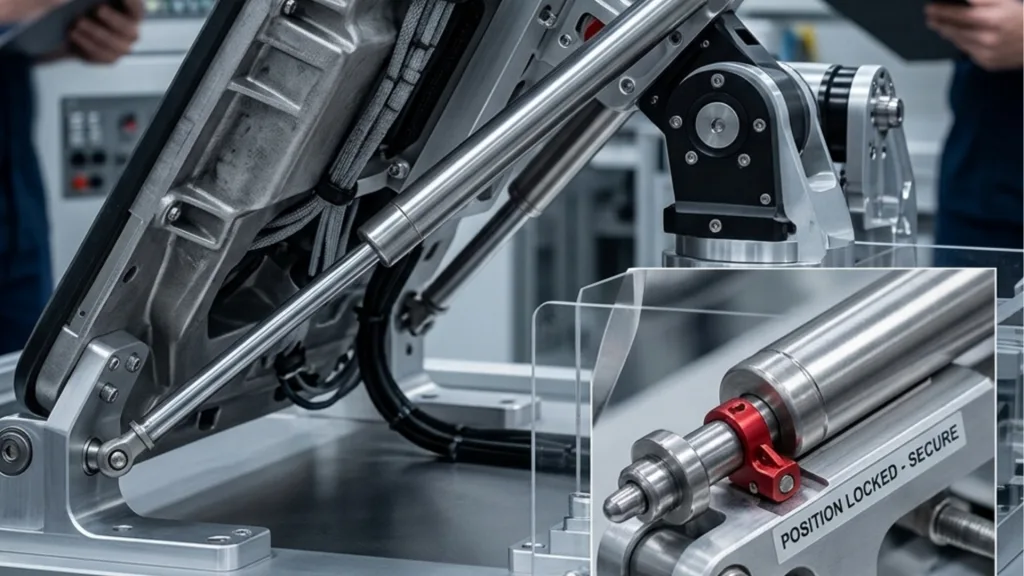
These incorporate internal locking mechanisms holding the rod at any intermediate position. The lock engages through a lever or pin, preventing unintended extension or compression. Applications include adjustable machinery guarding, positioning equipment, and height-adjustable platforms.
Monotube Versus Dual-Chamber Designs:
Standard gas struts employ monotube construction single cylinder containing both gas and hydraulic fluid. Dual-chamber designs separate gas into a secondary chamber, enabling more sophisticated damping and force profiles. Dual-chamber designs cost more but enable exceptional precision in demanding applications.
Soft-Stop and Progressive Damping:
Advanced designs incorporate progressive damping that increases as the rod approaches full travel. This creates soft-stop action gentle deceleration near endpoints. Some designs feature programmable damping adapting to changing loads or conditions.
Temperature-Compensated Designs:
Specialized gas struts maintain consistent force and damping across wide temperature ranges. These suit outdoor applications or facilities with extreme temperature cycling. Malaysian facilities with exposed equipment benefit significantly from temperature compensation.
Corrosion-Resistant Materials:
For marine environments, chemical processing facilities, and coastal installations, gas struts employ stainless steel cylinders or specialized protective coatings. These cost more initially but deliver significantly longer service life in corrosive environments.
Gas Struts vs the Competition
Understanding gas struts means appreciating how they compare to alternative motion control solutions. Gas struts consistently offer the best balance of performance, durability, cost-effectiveness, and minimal maintenance compared to mechanical springs, air cylinders, electric actuators, or traditional pulley systems.
Mechanical springs provide good force control but poor damping and require frequent maintenance. Air cylinders offer moderate performance at lower cost but with shorter lifespans. Electric actuators deliver superior control but cost significantly more and require electrical infrastructure. Pulleys and counterweights remain outdated for most modern applications.
Gas struts excel by combining excellent force control, superior damping, 5-15 year lifespans, moderate cost, and minimal maintenance requirements making them the optimal choice for most applications across automotive, industrial, medical, and architectural sectors.
Conclusion
Gas struts represent elegant engineering solutions solving complex motion control problems through straightforward physical principles. Compressed nitrogen gas creates supporting force, while hydraulic fluid damping provides smooth, controlled motion. This combination delivers reliability, longevity, and minimal maintenance across thousands of applications worldwide.
Understanding how gas struts work enables better equipment selection, proper maintenance practices, and troubleshooting when performance issues arise. Knowledge of gas strut operation deepens appreciation for this sophisticated yet fundamentally simple mechanism.
From automotive hoods to industrial machinery, medical equipment to architectural systems, gas struts enable motion control and load support that would be difficult to achieve with traditional mechanical systems. As equipment becomes more sophisticated, gas spring technology continues evolving with advanced designs addressing specialized requirements.
For applications requiring controlled motion, smooth force delivery, or load support, discover how professional-grade gas springs solutions enhance performance and reliability. Explore our comprehensive gas springs product selection to find the ideal solution for your engineering requirements.
Visit Eumation to learn more about our complete range of spring solutions. For additional company information, visit our About page.
Contact Eumation’s engineering team today for personalized consultation on your gas strut requirements.