
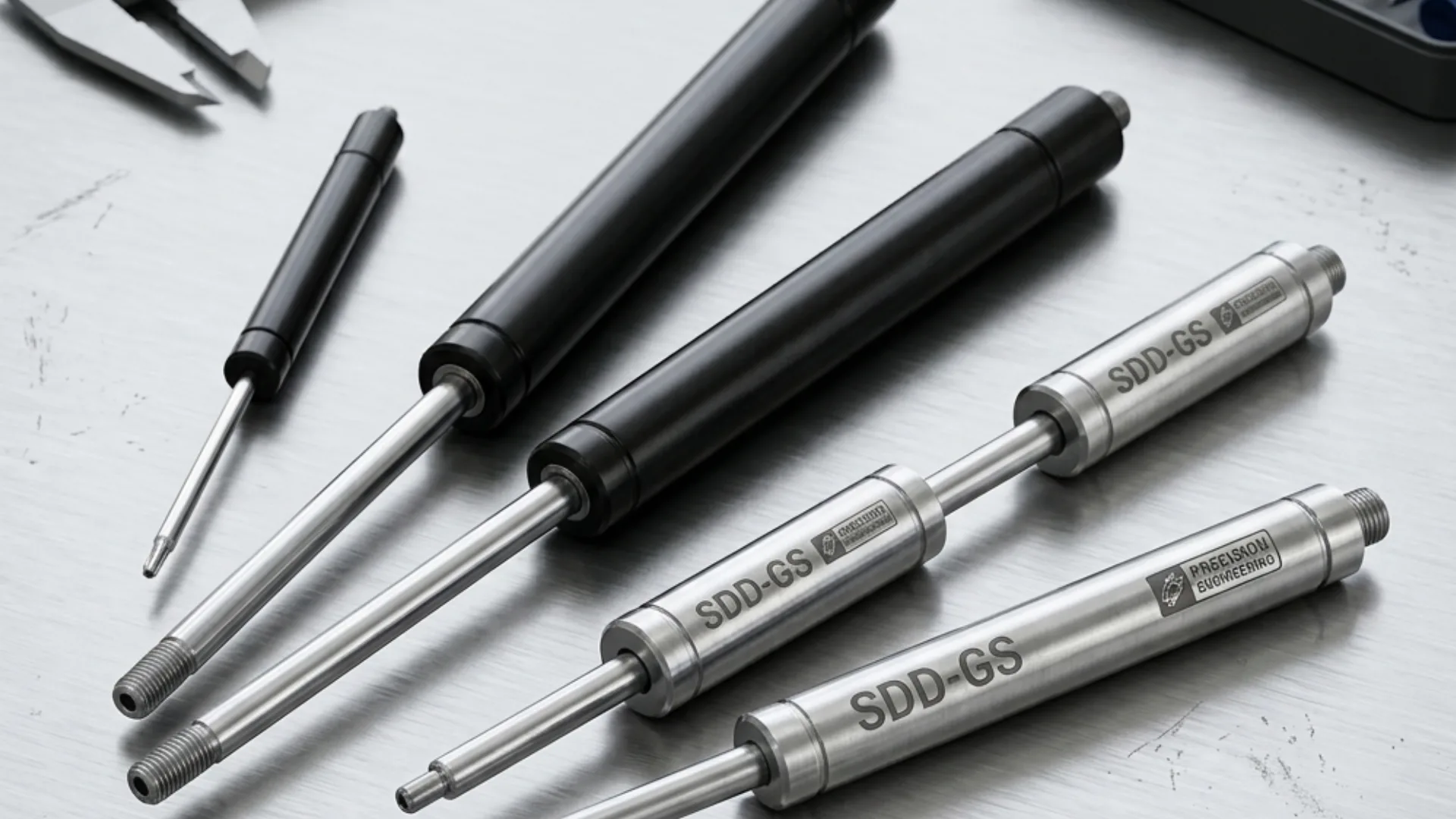
Selecting the right gas spring cylinder sounds straightforward until you’re standing in front of a specification sheet with dozens of force ratings, stroke lengths, end fitting configurations, and temperature ratings, and the wrong choice means a machine lid that slams shut, a press tool that fails to return, or an access panel that slowly drifts closed mid-maintenance.
In Malaysia’s manufacturing and engineering sectors from automotive suppliers in Selangor to furniture manufacturers in Johor gas springs are used in thousands of applications where controlled force, precise motion, and long service life are non-negotiable. Yet they remain one of the most commonly under-specified components in machine design. Engineers grab the nearest available unit, or copy a previous BOM without reviewing whether the specification actually fits the new application.
This guide walks you through every variable that matters when choosing a gas spring cylinder, so you can make a confident, technically sound decision every time. If you’re sourcing for a Malaysian operation, it’s also worth looking at Hahn Gasfedern precision gas springs available through Eumation a product line built for exactly these kinds of demanding industrial applications.
What Is a Gas Spring Cylinder?
Before getting into selection criteria, it helps to be clear on what a gas spring cylinder is and how it works because misconceptions at this stage lead to poor specification choices later.
A gas spring is a sealed pneumatic actuator containing compressed nitrogen gas (not air nitrogen is chemically inert and dry, which matters for longevity) and typically a small quantity of oil for lubrication and sealing. When the piston rod is pushed inward, the nitrogen compresses further, increasing the resistive force. When the external load is released, the stored gas pressure pushes the rod back to its extended position.
Key Differences from Mechanical Springs
Gas spring cylinders offer several fundamental advantages over traditional coil or torsion springs:
- Progressive force curve force increases gradually as the rod is compressed, unlike the sharp linear response of coil springs, which makes them easier to control in ergonomic applications
- Compact envelope a gas spring cylinder can deliver high force in a much smaller physical package than an equivalent coil spring
- Consistent force output unlike springs that fatigue and lose tension over time, properly sealed gas springs maintain their output force throughout their rated service life
- Integrated damping the oil in the cylinder provides inherent damping, which smooths motion and reduces impact at end of stroke
These characteristics make the gas spring cylinder the preferred solution in machine tool guarding, automotive boot lids and bonnets, industrial enclosure doors, office furniture mechanisms, and medical equipment any application where controlled, reliable force over a long service life is required.
5 Parameters to Specify a Gas Spring Cylinder
Every gas spring cylinder selection starts with five numbers. Get these right, and the rest of the specification process is straightforward. Get them wrong, and you’ll be dealing with premature failure, unsafe operation, or a unit that simply doesn’t fit.
1. Required Extension Force (F1)
Extension force the force the gas spring exerts when fully extended is the primary specification. It is measured in Newtons (N) and must be sufficient to support or counterbalance the load applied to the cylinder.
For a counterbalancing application (for example, holding a machine access cover open), calculate:
F1 = (Load weight × Distance from hinge to load centre of gravity) ÷ Distance from hinge to gas spring mounting point
Always add a safety margin of 15–20% above the calculated value to account for friction, seal resistance, and temperature variation.
2. Stroke Length
Stroke is the distance the piston rod travels between its fully extended and fully compressed positions. It must match the physical travel required in your application no more, no less. Using a gas spring cylinder with excessive stroke in a constrained space risks bottoming out the unit or creating an unsafe over-extension condition.
Measure the actual travel of the component being moved, then select the next standard stroke length above your measured value.
3. Compressed and Extended Lengths
These are the physical envelope dimensions of the cylinder. Your mounting geometry must accommodate the gas spring at both ends of its travel fully extended and fully compressed. This is where many engineers make errors, designing the mounting points based only on the extended length and then discovering there is insufficient clearance at the compressed end.
4. End Fitting Configuration
Gas springs attach to the machine structure and the moving component via end fittings. Common configurations include:
- Ball socket and pin the most common, allowing angular misalignment of up to 25–35°
- Clevis bracket for applications requiring pivoting attachment at both ends
- Threaded rod end for rigid, fixed-direction applications
- Integrated bracket for compact installations where space around the end fitting is limited
The end fitting must match both the geometry of your installation and the load direction. Applying lateral (side) loads to a gas spring not designed for them is a leading cause of premature seal failure.
5. Operating Temperature Range
This is the specification most commonly overlooked by Malaysian engineers and the one most relevant to local conditions. Gas spring force output is temperature-dependent: force increases as temperature rises, and decreases as temperature falls.
For outdoor or semi-outdoor applications in Malaysia’s tropical climate where equipment surface temperatures can reach 50–60°C in direct sun a gas spring specified at standard 20°C ambient will produce significantly higher extension forces in service than its rated value. This can cause lids to open too forcefully, damage hinges, or make covers difficult to close.
Always specify the operating temperature range and verify force output at your maximum expected temperature. Industrial-grade gas springs are typically rated for –20°C to +80°C, with high-temperature variants available for process environments above that range.
Types of Gas Spring Cylinder for Every Application
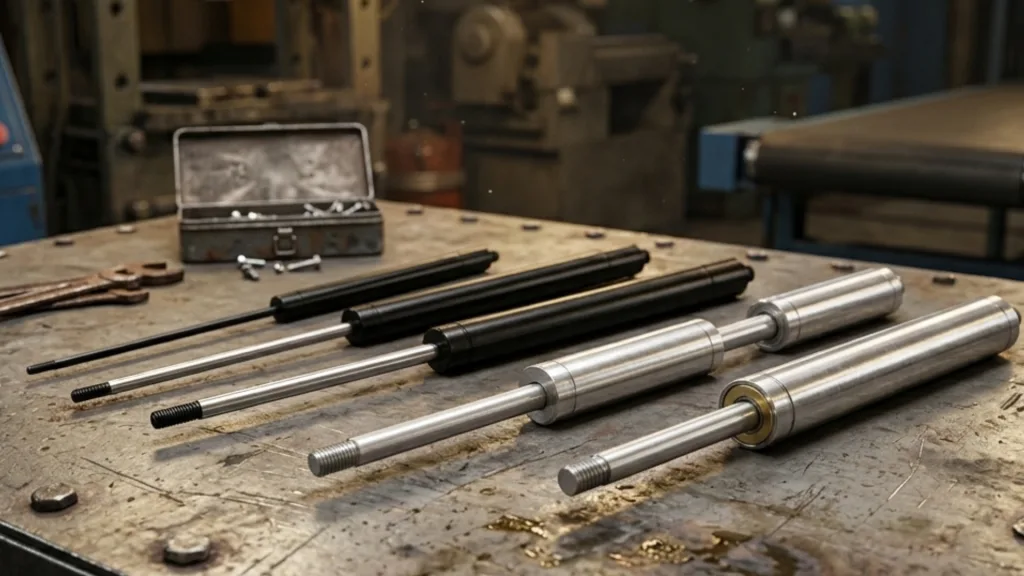
Not all gas spring cylinders are the same. The selection of cylinder type should follow the application requirements and there are more options than most engineers realise.
Standard Compression Gas Springs
The most common type. The rod is pushed inward against the gas pressure, and the spring returns to its extended position when released. Used in the vast majority of counterbalancing and return-force applications.
For Malaysian manufacturers sourcing standard compression gas springs for machine guarding, tooling fixtures, or equipment enclosures, the Hahn Gasfedern industrial range covers force outputs from 100N to over 15,000N, with a comprehensive selection of stroke lengths and end fittings that suits the breadth of applications found in Malaysian production facilities.
Tension Gas Springs (Extension Springs)
These operate in the opposite direction the spring force acts to pull the rod outward rather than push it. Used in applications where the load pulls the mechanism apart rather than pressing it together, such as certain automotive door check mechanisms and specialised industrial fixtures.
Lockable Gas Springs
Lockable variants incorporate a valve mechanism that allows the spring to be locked at any position in its stroke. This is essential in applications where the user needs to set and hold an intermediate position adjustable workstation monitors, ergonomic equipment, medical examination tables, and sit-stand desk mechanisms.
Damped Gas Springs
Standard gas springs have some inherent damping from their internal oil, but dedicated damped variants provide controlled deceleration at end of stroke. These are specified where a component must decelerate smoothly before reaching the end of its travel preventing impact damage in automotive tailgates, precision instrument covers, and high-cycle machine doors.
Free-Stroke Gas Springs
These allow a defined length of free travel at the start of the stroke before force builds up. Useful in applications where initial movement needs to be unimpeded such as opening a lid that must clear a seal before the counterbalancing force engages.
Gas Spring Cylinder Mounting and Installation Tips
A correctly specified gas spring cylinder can still fail prematurely if it is mounted incorrectly. Proper installation is as important as proper specification.
Rod-Down Orientation
Wherever possible, gas springs should be installed with the piston rod pointing downward. This keeps the internal oil in contact with the rod seal, ensuring continuous lubrication of the seal lip and maximising service life. Rod-up installation is possible with many units but typically reduces service life and may require a specific variant designed for that orientation always check the manufacturer’s data.
Avoiding Lateral Loading
Gas springs are designed for axial loading force applied directly along the cylinder axis. Any lateral (side) load on the rod causes uneven wear on the rod guide and seal, leading to premature leakage. In practice, this means:
- Mounting points must be co-linear with the cylinder axis throughout the full stroke
- End fittings must be able to pivot freely to accommodate any angular changes in load direction
- Never use a gas spring as a structural element to resist side or bending loads
Mounting Point Geometry
The distance between mounting points at both ends of the stroke must be checked carefully. A common design error is to check only the geometry at the mid-stroke or extended position. At the compressed position, the cylinder shortens by the full stroke length and the mounting geometry must accommodate this without binding, over-extending adjacent components, or creating unsafe angles.
Maintenance and Replacement Intervals
Gas springs do not require routine maintenance in normal service no lubrication, no adjustment. However, they do have a finite service life measured in operating cycles. Industrial-grade units typically carry ratings of 100,000 to 500,000 cycles depending on force level and application conditions. Track operating cycle counts in high-frequency applications and plan for replacement before seal degradation leads to sudden loss of function.
Common Gas Spring Cylinder Specification Mistakes
Even experienced engineers make recurring errors when specifying gas spring cylinders. Knowing where the mistakes happen is the fastest way to avoid them.
Specifying by Feel Rather Than Calculation
“It felt about right on the prototype” is not a specification. Forces that feel acceptable during manual testing may be unsafe or inadequate in production conditions, at different temperatures, or after the unit has cycled 10,000 times. Always calculate the required force from first principles and verify against the manufacturer’s force-temperature data.
Ignoring the Force Differential
Gas spring force increases from F1 (extended) to F2 (compressed) as the rod is pushed in. The ratio F2/F1 called the progression ratio is typically 1.3–1.7 for standard units. In applications where a consistent force is required throughout the stroke, specifying a unit with too high a progression ratio produces an end-of-stroke force that is significantly higher than the beginning-of-stroke force, which can cause binding, damage, or discomfort in ergonomic applications.
Underestimating Environmental Conditions
Malaysia’s industrial environments often expose equipment to elevated humidity, oils, coolants, and cleaning chemicals. Standard gas springs with chrome-plated rods and standard seals may not provide adequate corrosion resistance in these conditions. Stainless steel rod variants and chemical-resistant seal materials are available for demanding environments and are worth the additional cost when the alternative is premature failure in a difficult-to-access location.
Buying on Price Alone
The cost difference between a quality industrial gas spring and a cheaper generic substitute is modest. The cost difference in downtime, replacement labour, and in safety-critical applications incident investigation, is not. For Malaysian manufacturers supplying international OEMs with strict component traceability requirements, product certification and documentation from the gas spring supplier is also a procurement consideration.
Conclusion
Choosing a good gas spring cylinder comes down to disciplined specification, an understanding of the operating environment, and selecting the right variant for the specific application. The five core parameters extension force, stroke, physical length, end fitting, and operating temperature must all be defined before a unit is selected. Type selection, mounting geometry, and orientation complete the picture.
For engineers and procurement teams in Malaysia, working with a technically capable supplier who can support the specification process makes a meaningful difference particularly in complex or safety-critical applications where the cost of getting it wrong far exceeds the cost of getting it right.
To explore the full Hahn Gasfedern gas spring cylinder range and get technical support for your application, visit Hahn-Gasfedern. For a broader view of the precision industrial components available for Malaysian operations, explore Eumation and connect with the team directly.