
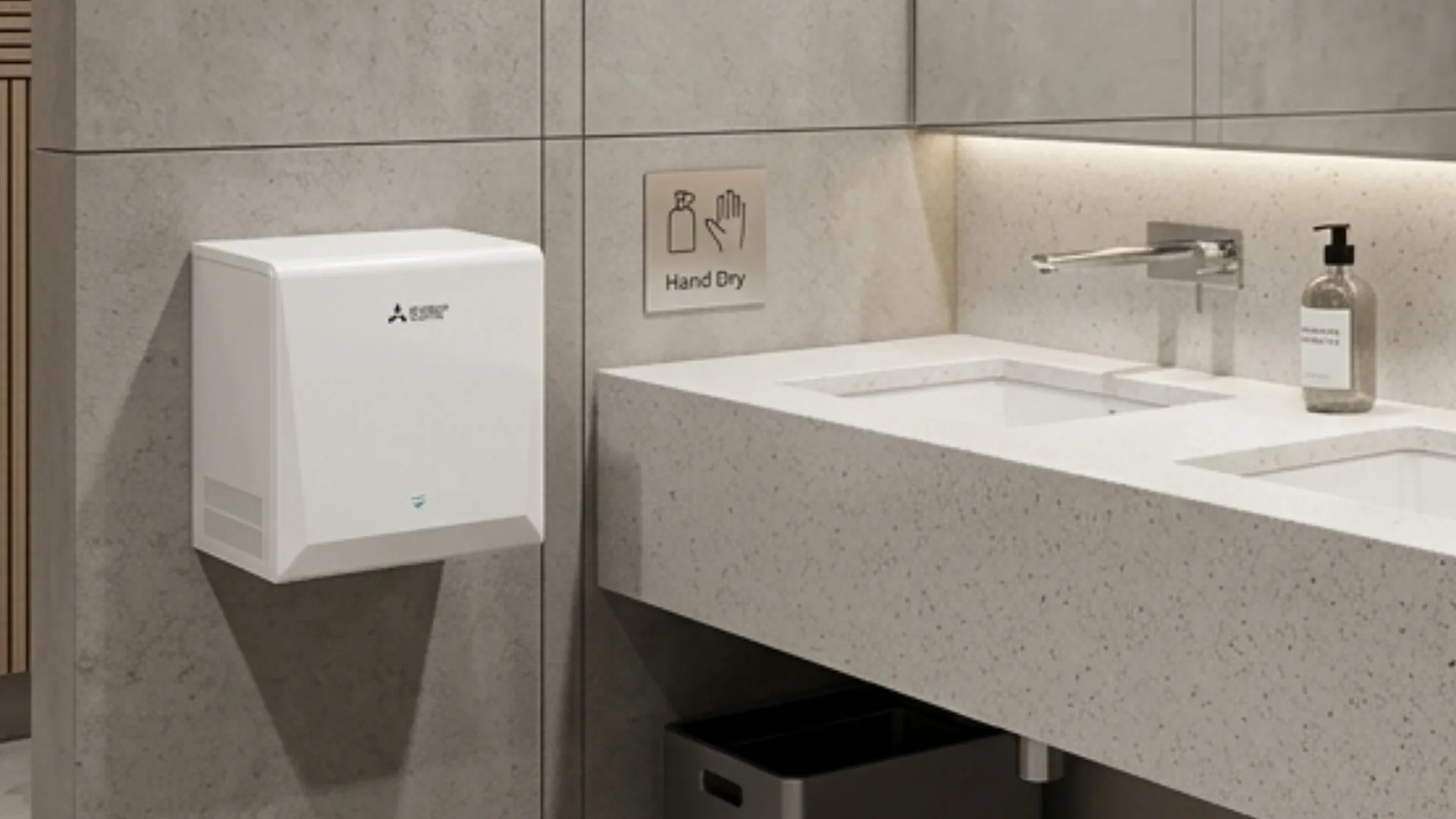
Rising electricity expenses concern facility managers across Malaysia. In commercial spaces from office buildings to shopping malls, hotels to healthcare facilities hand dryers represent an overlooked cost reduction opportunity. Traditional hand dryers consume considerable energy, but energy saving hand dryer technology offers practical solutions that don’t compromise performance or hygiene.
By switching to efficient models, Malaysian businesses can reduce annual electricity costs by 50-70% while improving user experience and supporting sustainability. This guide covers mechanisms behind energy-efficient hand dryers, financial benefits, and actionable steps for reducing facility expenses. For comprehensive information on advanced solutions, explore our complete hand dryer product selection.
Energy Consumption in Hand Dryers: Where Costs Add Up
Before implementing solutions, understand where energy waste occurs. Most traditional hand dryers heat air to 40-50°C and circulate it continuously over users’ hands. This approach has remained largely unchanged for decades.
The Energy Drain Problem:
Conventional hand dryers consume 1200-1400 watts during operation. The drying mechanism relies heavily on heat-based evaporation, running at full power for 30-45 seconds per use, often longer.
In a busy restroom with 100-150 daily users, a single conventional hand dryer operates roughly 100 minutes daily. With 8-10 restrooms, daily energy consumption can exceed 15-20 kilowatt-hours.
Malaysia-Specific Cost Impact:
With electricity rates averaging RM 0.35-0.45 per kilowatt-hour, a mid-sized facility’s annual hand dryer costs range from RM 15,000-25,000. For larger properties, costs exceed RM 50,000 annually. These figures often go unnoticed because expenses are buried in monthly utility bills. During peak seasons, air-conditioned facilities work harder to compensate for heat generated by hand dryers.
Key Energy Waste Factors:
- Continuous high-power operation regardless of drying need
- Excessive heat raising ambient restroom temperature
- Extended drying times requiring multiple uses
- Inefficient AC motors with higher standby consumption
- Poor sensor technology causing unnecessary operation
How an Energy Saving Hand Dryer Works
Modern energy saving hand dryer technology changes the efficiency equation through innovative approaches. Rather than relying solely on heat, these systems use advanced motors, intelligent controls, and optimized airflow to achieve rapid drying with minimal energy.
High-Efficiency Motor Technology:
Energy saving dryers employ brushless DC motors instead of traditional AC motors. DC motors convert 85-90% of electrical input into useful work versus AC motors’ 60-75% efficiency—reducing consumption by 20-25% without compromising performance.
Advanced designs produce higher air velocity (100-150+ mph) while using less power. Increased velocity mechanically removes water droplets, requiring less heat for evaporation.
Intelligent Sensor Systems:
Premium models incorporate motion sensors and infrared detection optimizing runtime. Unlike conventional dryers operating continuously, intelligent systems deliver air only when needed and automatically cease once dryness is detected.
Advanced features include:
- Motion-activated initiation
- Moisture sensors detecting dryness
- Variable power settings
- Automatic shut-off timers
- Smart scheduling for off-peak hours
Power Consumption Advantages:
Energy saving dryers operate at 600-900 watts (40-50% less than conventional) and complete drying in 8-12 seconds versus 30-45 seconds. Combined benefits create significant savings:
- Daily savings: 5-8 kilowatt-hours per restroom
- Annual savings (single unit): RM 1,800-2,800
- Annual savings (10-unit facility): RM 18,000-28,000
For multiple-facility implementations, cumulative impact is substantial. Explore our premium energy-efficient hand dryer solutions for models optimized for Malaysia.
Implementation Strategies for Maximum Savings
Reducing energy costs requires strategic planning beyond equipment replacement. Success involves assessment, installation planning, and ongoing optimization.
Phase 1: Facility Audit and Assessment:
Conduct a thorough audit documenting:
- Number of hand dryers per restroom
- Model specifications and age
- Current electricity consumption
- Peak usage times and traffic patterns
- User satisfaction levels
- Maintenance frequency and costs
This baseline helps calculate potential savings. Prioritize high-traffic restrooms (main lobbies, commercial centers) for maximum ROI.
Phase 2: Strategic Replacement Planning:
Rather than replacing simultaneously, implement phases:
- High-traffic restrooms (200+ daily users) – ROI in 18-24 months
- Guest-facing facilities – enhances user perception
- Secondary restrooms – moderate usage areas
- Low-traffic facilities – employee areas
This distributes capital expenditure while delivering immediate cost savings.
Phase 3: Installation and Configuration:
Professional installation ensures optimal performance:
- Verify electrical infrastructure compatibility
- Position dryers for maximum coverage
- Calibrate sensor sensitivity for tropical humidity
- Test airflow patterns
- Train staff on maintenance
Phase 4: Monitoring and Optimization:
Track performance metrics:
- Monthly energy consumption versus baseline
- User satisfaction scores
- Maintenance incidents
- ROI realization timeline
Regular monitoring ensures sustained savings throughout equipment lifespan.
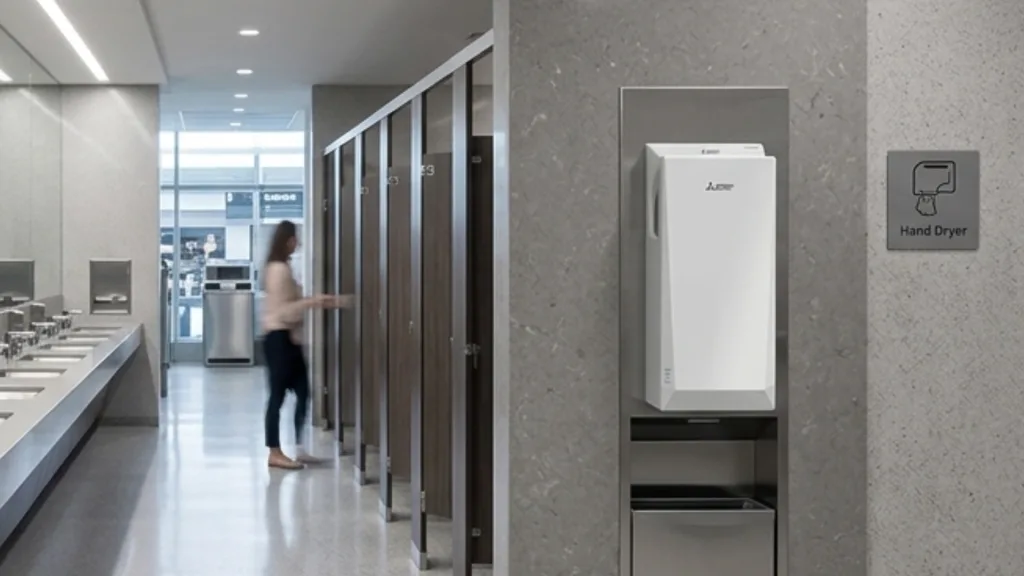
Energy Saving Hand Dryer: ROI & Long-Term Savings
Understanding the complete financial picture justifies capital investment in energy saving hand dryer technology. While initial costs are higher than conventional alternatives, long-term benefits are compelling.
Initial Investment Comparison:
- Conventional hand dryer: RM 800-1,200 per unit
- Energy saving hand dryer: RM 2,000-3,500 per unit
- Additional cost per unit: RM 1,200-2,300
For a 10-unit upgrade, additional investment is RM 12,000-23,000. However, energy savings justify this quickly.
5-Year Financial Projection:
| Cost Category | Conventional (10 units) | Energy Saving (10 units) | Savings |
| Equipment Cost | RM 10,000 | RM 25,000 | – |
| Annual Energy | RM 150,000 | RM 45,000 | RM 105,000 |
| Maintenance (5 years) | RM 5,000 | RM 3,000 | RM 2,000 |
| Total 5-Year | RM 165,000 | RM 73,000 | RM 92,000 |
Over five years, energy saving dryers save RM 92,000 (56% reduction). The additional RM 15,000 investment recovers in approximately 18 months through energy savings alone.
10-Year Analysis:
- Conventional system: RM 305,000 (including replacement)
- Energy saving system: RM 130,000
- Total savings: RM 175,000 (57% reduction)
Beyond financial metrics, upgrades reduce annual carbon emissions by 150-200 metric tons CO2 equivalent—equivalent to removing 40-50 cars from roads annually, supporting environmental sustainability goals.
Energy Saving Hand Dryer Maintenance Best Practices
To ensure sustained efficiency and maximize ROI, proper maintenance is essential. Well-maintained systems operate at peak efficiency throughout their 10-12 year lifespan.
Regular Maintenance Schedule:
|
Frequency |
Tasks |
| Monthly | Visual inspection for damage, Nozzle cleaning, Sensor verification, Operational noise check |
| Quarterly | Deep filter cleaning, Sensor calibration verification, Performance testing, Documentation of usage metrics |
| Annually | Professional service examination, Motor and bearing inspection, Electrical connection verification, Filter replacement, Firmware updates for smart models |
Specialized Maintenance for Malaysia’s Climate:
Tropical conditions create specific maintenance challenges:
- Higher humidity requires frequent filter inspection
- Salt air corrosion in coastal facilities demands protective coatings
- Temperature fluctuations necessitate sensor recalibration
- Extended monsoon seasons increase ambient moisture affecting sensor performance
Preventive maintenance ensures facilities achieve 95%+ uptime and maintain specified energy efficiency metrics throughout the equipment lifespan.
Comparing Energy Saving Options: Which Technology Wins?
Multiple energy-saving technologies exist; understanding their relative advantages helps identify the best fit for your specific needs.
| Feature | High-Speed Velocity | Heated Air (Moderate) | Hybrid Systems |
| Drying Time | 8-12 seconds | 15-25 seconds | 10-15 seconds |
| Air Velocity | 100-150+ mph | 60-80 mph | 90-130 mph |
| Heat Dependency | Lowest | Moderate | Low-Moderate |
| Energy Efficiency | Highest (50-70% reduction) | Good (25-40% reduction) | Premium (55-75% reduction) |
| Hygiene Profile | Excellent | Good | Excellent |
| Initial Cost | Premium | Moderate | Highest |
| Sensor Integration | Standard | Basic | Excellent |
| Ideal For | High-traffic, humid environments | Mid-range facilities, moderate traffic | Premium facilities, variable climates |
| Malaysia Suitability | Excellent | Good | Very Good |
For Malaysian facilities, high-speed velocity dryers typically offer the best balance of energy savings, tropical humidity performance, and long-term ROI. Browse our complete range of energy-efficient models for solutions suited to your specific requirements.
Challenges When Switching to an Energy Saving Hand Dryer
While benefits are clear, several practical challenges arise during implementation. Planning ahead ensures smooth transitions.
Challenge 1: User Adoption and Behavioral Change:
Some users may resist high-speed alternatives due to unfamiliarity with intense air velocity.
Solution: Place informational signage explaining benefits. Educational materials help users understand rapid drying. Most adapt within 2-3 weeks.
Challenge 2: Initial Performance Concerns:
Some facilities report occasional sensor sensitivity issues in initial weeks, particularly in high-humidity environments.
Solution: Professional calibration during installation prevents most issues. Request technician training for facility staff on sensitivity adjustment for local humidity.
Challenge 3: Capital Budget Constraints:
Higher upfront costs create budgeting challenges.
Solution: Implement phased replacement starting with highest-ROI areas. Some suppliers offer lease-to-own programs aligning payments with achieved energy savings.
Challenge 4: Infrastructure Compatibility:
Existing electrical infrastructure may require upgrades.
Solution: Include electrical assessment in facility audit. Most facilities accommodate upgrades with minor modifications (RM 2,000-5,000), justified within 6-12 months of energy savings.
Conclusion
Cutting energy costs through energy saving hand dryer technology represents one of the highest-ROI facility management decisions for Malaysian businesses. Reduced electricity consumption, lower maintenance costs, improved user experience, and environmental benefits create compelling financial and operational justification.
The numbers are clear: a mid-sized facility upgrading to energy saving dryers can expect RM 18,000-28,000 in annual savings, with complete ROI in 18-24 months. Over a 10-year lifespan, savings exceed RM 150,000-200,000. These figures demonstrate that energy-efficient upgrades are not optional expenses but strategic investments.
Beyond financial metrics, energy-efficient facilities demonstrate sustainability commitment while enhancing restroom experience for visitors and employees. In today’s environmentally conscious business environment, this alignment with corporate values increasingly influences facility management decisions and enhances brand reputation.
Begin with a comprehensive facility audit to establish baseline energy consumption and identify priority areas. Explore available technology options optimized for Malaysia’s tropical climate and humidity conditions. Review our advanced hand dryer solutions and premium models to understand the full range of energy-efficient technology available.
Ready to transform your facility’s energy profile? Contact Eumation’s team for personalized energy assessment and implementation planning. Whether upgrading a single restroom or optimizing an entire property, energy saving hand dryer solutions deliver measurable cost reduction, improved efficiency, and sustainability outcomes. Visit Eumation to learn more about facility solutions and schedule your consultation. You can also visit our about page for company information and expertise.
Take control of your energy costs upgrade to energy saving hand dryer technology now.