
When engineers and procurement teams set out to solve a motion control problem holding a heavy lid open, returning a tool to its home position, or controlling the movement of an industrial panel they often face the same fork in the road: gas springs or an electric actuator? Both technologies move things. Both can apply controlled force. But they operate on fundamentally different principles, carry different cost profiles, and suit very different application requirements.
In Malaysia’s growing advanced manufacturing sector from medical device assembly in Cyberjaya to automotive component production in Shah Alam making the wrong choice between these two technologies can mean overspending on complexity your application doesn’t need, or under-specifying a solution that cannot handle what you’re asking of it.
This guide delivers a clear, technically grounded comparison of gas springs and electric actuators across every dimension that matters: operating principle, cost, control capability, maintenance, and the real-world scenarios where each technology wins. For engineers already familiar with gas spring technology, the Hahn Gasfedern precision gas spring range at Eumation provides a useful reference point for what the technology can achieve at the industrial level.
How a Gas Spring and Electric Actuator Work
Before comparing performance, it is worth being precise about what each technology actually does because the differences in operating principle drive almost every other distinction in the comparison.
How Gas Springs Generate Force
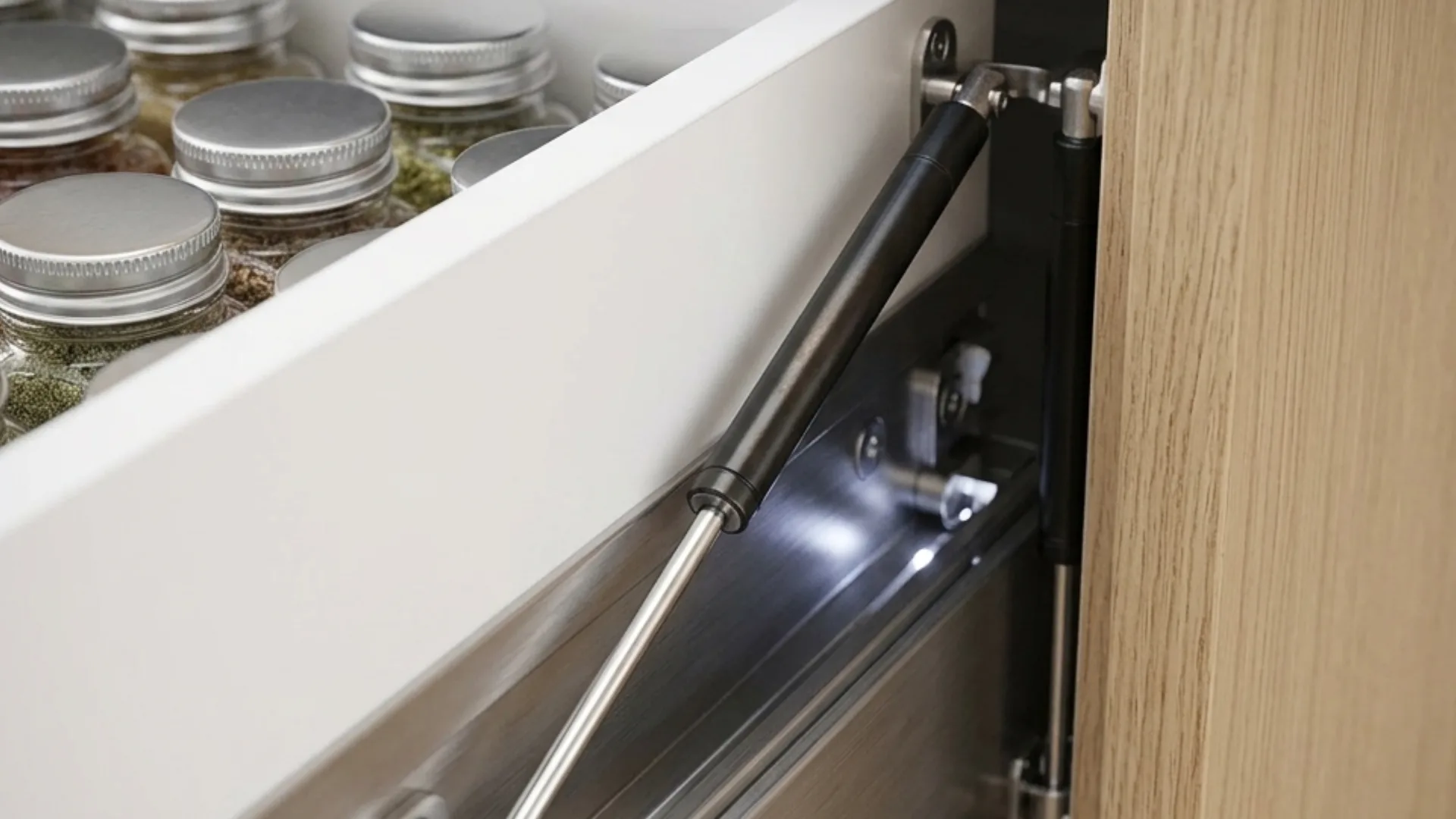
A gas spring is a sealed cylinder containing compressed nitrogen gas and a small volume of hydraulic oil. When the piston rod is pushed inward, the nitrogen compresses further and the resistive force increases progressively. When the external load is removed, stored gas pressure pushes the rod back to its fully extended position.
The result is a passive force element one that stores and releases energy without any external power supply, control system, wiring, or programming. The force it exerts is determined entirely by its internal gas charge, which is set at manufacture. Once installed, a gas spring just works, cycle after cycle, without needing to be told to.
Key characteristics of gas spring operation:
- Passive and self-contained no power supply, no controller, no wiring required
- Progressive force curve force increases from the extended (F1) to compressed (F2) position, typically by a ratio of 1.3–1.7
- Inherent damping internal oil provides natural deceleration at end of stroke
- Fixed force output cannot be adjusted after manufacture without specialist equipment
- Very high cycle life 100,000 to 500,000+ cycles in well-specified applications
How Electric Actuator Generate Force
An electric actuator converts electrical energy into linear or rotary mechanical motion using a motor typically a brushless DC or stepper motor driving a lead screw, ball screw, or belt mechanism. The motor is commanded by a controller (PLC, servo drive, or microcontroller) that determines speed, position, force, and direction.
Unlike gas springs, electric actuators are active systems. They require power to hold a position, power to extend, and power to retract. They can be programmed to move to precise positions, apply specific forces at specific points in the stroke, and vary their behaviour dynamically based on sensor feedback.
Key characteristics of electric actuator operation:
- Active and programmable speed, position, force, and direction are all controllable
- Precise positioning can achieve sub-millimetre repeatability with encoder feedback
- Holds position under power can maintain a specific position without mechanical locking
- Requires infrastructure power supply, cabling, controller, and often safety interlocks
- More complex maintenance motor, drive electronics, and mechanical transmission all require monitoring
Gas Spring vs Electric Actuator: Cost Comparison
Cost is rarely just the purchase price. For motion technology, the real financial picture only emerges when you account for installation, energy consumption, maintenance, and service life.
Gas Springs: Low Cost, Low Complexity
A quality industrial gas spring cylinder such as those in the Hahn Gasfedern product range typically costs between RM 80 and RM 800 depending on force rating, stroke, and variant. Installation requires only two mounting points and basic hardware. No wiring, no programming, no control cabinet.
Running cost is effectively zero gas springs consume no electricity. They require no scheduled maintenance beyond periodic inspection, and in clean industrial environments, a well-specified unit will exceed 500,000 cycles before requiring replacement.
Total cost of ownership for a gas spring application over a 5-year period in a typical Malaysian manufacturing environment:
- Unit cost: RM 150–500
- Installation: 1–2 hours of technician time
- Energy cost: RM 0
- Maintenance: Minimal visual inspection only
- Replacement: Planned at cycle life limit
Electric Actuators: Higher Investment, Greater Capability
A basic industrial electric actuator starts at RM 800–2,000 for the mechanical unit alone. Add a motor drive or servo controller (RM 500–3,000), wiring and cable management, a safety relay, and integration with the machine PLC, and a single axis of electric actuation can easily cost RM 5,000–15,000 installed.
Running costs are low but not zero the motor draws current whenever it is operating or holding position. Maintenance involves periodic inspection of the drive mechanism, motor health monitoring, and eventual replacement of the ball screw or lead screw after the rated travel distance is exceeded.
The conclusion is clear: where a gas spring can meet the application requirements, it will almost always be the more cost-effective solution by a significant margin. The electric actuator justifies its higher cost only when the application genuinely requires programmable control, precise positioning, or variable force output.
Where Electric Actuators Pull Ahead
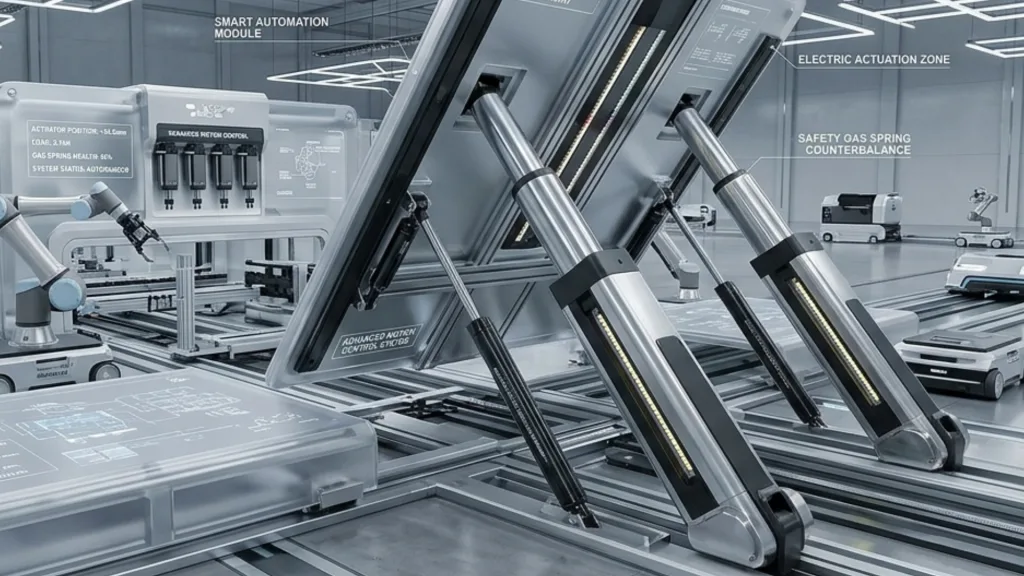
If cost comparison favours gas springs, the control comparison is where electric actuator establish their territory. There are categories of application where the programmability of an electric actuator is not a luxury it is a functional necessity.
Applications Requiring Precise Position Control
Gas springs move to one of two states: extended or compressed (with lockable variants allowing intermediate positions, but without feedback). An electric actuator with encoder feedback can move to any position within its stroke with repeatability of ±0.05mm or better.
This level of precision is essential in:
- Automated assembly fixtures where the actuator must position a component to a specific coordinate before a fastener is applied
- Adjustable tooling and jigs where the same machine must accommodate different product variants at different positions
- Medical and laboratory equipment where positioning accuracy directly affects measurement or treatment outcomes
- Semiconductor handling equipment common in Penang’s electronics manufacturing cluster, where sub-micron positioning requirements make gas springs completely unsuitable
Applications Requiring Variable or Programmable Force
Electric actuator can be programmed to apply a specific force at a specific point in the stroke and to change that force profile dynamically based on sensor feedback or recipe selection. This is valuable in:
- Controlled press-fit operations where insertion force must be monitored and recorded
- Testing and quality assurance machines that apply defined load profiles to components
- Adaptive clamping systems where holding force must vary based on part geometry
Gas springs cannot replicate this behaviour. Their force output is determined by internal gas charge and position in the stroke both fixed at manufacture.
Applications Requiring Remote Operation and Monitoring
An electric actuator can be integrated into a machine’s control system to receive commands, report position, log cycle counts, and signal faults. In Industry 4.0-ready facilities increasingly relevant for Malaysian manufacturers supplying global OEMs with smart factory requirements this connectivity is a genuine requirement.
Gas springs operate entirely outside the control system. They have no feedback capability and cannot report their status to a PLC or SCADA system.
Where Electric Actuators Outperform Gas Springs
The previous section outlines what electric actuators can do that gas springs cannot. But this comparison only tells half the story. In a broad class of applications, gas springs are not just cheaper they are genuinely better.
Counterbalancing and Weight Support
The classic gas spring application is counterbalancing a heavy, hinged component a machine access cover, a vehicle boot lid, a cabinet door, an equipment panel. For this task, gas springs are essentially ideal:
- They provide continuous, passive counterbalancing force without consuming power
- They require no controller, no wiring, and no programming
- They are inherently fail-safe if power fails, the spring continues to hold the load
- They handle the angular geometry of a hinged application naturally, as the force vector changes through the arc of movement
An electric actuator performing the same task would need to be powered continuously to hold the lid open, would require interlocks to prevent the lid dropping on power loss, and would add cost and complexity far beyond what the application warrants.
High-Cycle, Low-Maintenance Applications
In applications cycling many thousands of times per day press tooling return springs, fixture clamping elements, ejection mechanisms gas springs offer a service life and maintenance profile that is difficult to match with an electric actuator. There are no motor windings to inspect, no drive electronics to monitor, no ball screw preload to check.
Space-Constrained Installations
Gas springs are compact passive elements. An electric actuator of equivalent force capacity requires not only the mechanical unit but also a motor, a cable connection, and clearance for the cable to flex through the stroke. In tight machine envelopes, this additional bulk can make electric actuation impractical.
Environments Where Electronics Are Problematic
Wet environments, paint spray areas, high-temperature process zones, and areas with significant electromagnetic interference can all compromise the electronics of an electric actuator. Gas springs have no electronics they are fully mechanical and can be sealed to IP67 or higher for demanding environments.
When to Choose a Gas Spring Over an Electric Actuator
After reviewing both technologies, the practical question is how to apply this knowledge to a real specification decision. The following framework helps engineers and project teams quickly identify which technology is appropriate.
Choose Gas Springs When:
- The application is counterbalancing, weight support, or passive return force
- No position feedback or programmable force profile is required
- Budget is constrained and simplicity is valued
- The installation environment is hostile to electronics
- High cycle life with minimal maintenance is a priority
- Power supply to the actuator location is unavailable or inconvenient
Choose an Electric Actuator When:
- Precise, repeatable positioning to specific coordinates is required
- The force profile needs to vary or be programmable
- The actuator must be commanded remotely and integrated with a control system
- The application requires position monitoring, fault reporting, or data logging
- Multiple positions within the stroke need to be accessed under programme control
- The application is part of an automated or semi-automated machine sequence
Hybrid Approaches
Some applications benefit from both technologies. A machine where a heavy lid needs to be counterbalanced (gas spring) and then positively locked in multiple positions (electric lock or actuator) is a legitimate design combining both. Understanding where each technology contributes its strength allows engineers to build more elegant, cost-effective solutions than using a single technology for everything.
Conclusion
Gas springs and electric actuator are not rivals in the same market they are complementary technologies that each excel in a defined domain. Gas springs win on simplicity, cost, passive reliability, and suitability for counterbalancing and return-force applications. Electric actuator win on programmability, precision positioning, control integration, and applications requiring dynamic force profiles.
For Malaysian engineers and procurement teams evaluating motion solutions, the starting question should always be: does this application require active control, or does it simply need a reliable, passive force element? If the answer is the latter, a gas spring will almost certainly be the more practical, more durable, and more cost-effective choice.
To explore the full range of industrial gas springs available for Malaysian applications, visit Hahn-Gasfedern and connect with the team for application-specific technical support. For a broader view of precision industrial components and solutions available through Eumation.