
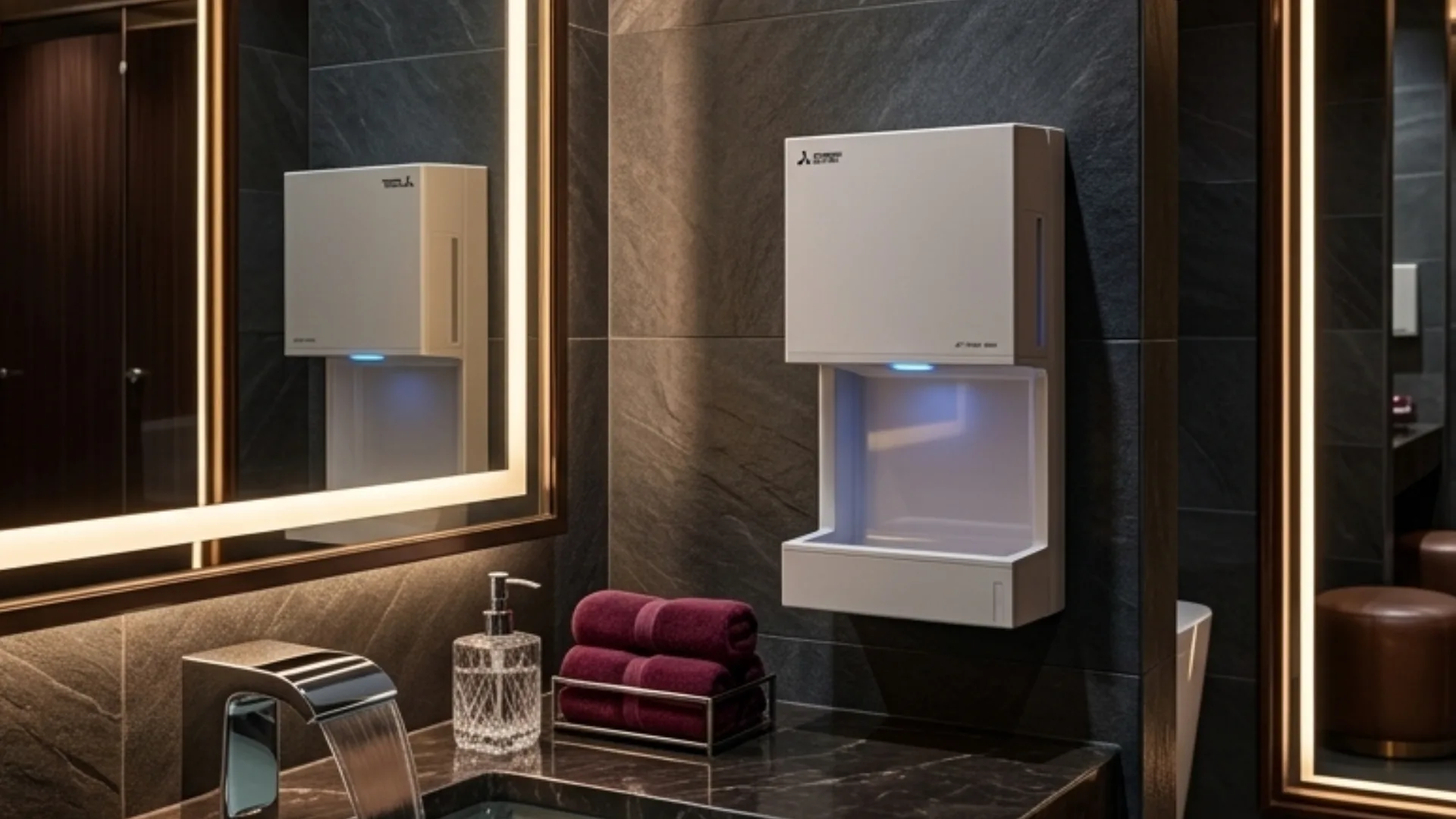
Walk into any commercial washroom in Malaysia from a gleaming mall in Kuala Lumpur to a busy airport lounge in Penang and you’ll find one of two things waiting after the sink: a hand dryer on the wall or a dispenser stacked with paper towels. It seems like a small decision, but for facility managers and building owners, it has significant implications for cost, hygiene, sustainability, and user experience.
The debate between hand dryers and paper towels has been running for decades, and the answer is no longer as simple as personal preference. Today, the choice involves environmental data, operational budgets, hygiene science, and evolving expectations from building users.
This guide offers a thorough, unbiased comparison to help you make the right decision for your facility. If you’re already leaning towards a high-efficiency drying solution, it’s worth exploring Mitsubishi’s Jet Towel range for Malaysian properties a product that has quietly raised the bar for what washroom hand drying can look like.
Hand Dryer vs Paper Towels: Real Cost Breakdown
When facilities teams first consider switching from paper towels to hand dryers, the conversation almost always starts with money. And rightly so over a multi-year period, the financial difference is substantial.
Upfront vs Ongoing Costs
Paper towels feel cheap because the cost is spread across daily consumption. A single roll or pack seems affordable. But when you aggregate that across a high-traffic washroom operating 365 days a year, the numbers shift dramatically.
Consider a commercial washroom in a mid-sized Malaysian office building with 150 staff and visitor use daily:
- Paper towels: At roughly RM 0.08–0.12 per towel, and an average of 2–3 towels per dry, that’s RM 0.20–0.36 per use. Multiplied by 150 uses/day × 365 days = RM 10,950–19,710 per year, not including waste disposal and restocking labour.
- Hand dryer: A quality unit costs RM 1,500–8,000 upfront. At 1,000W and a 10-second cycle, each use costs approximately RM 0.002 in electricity. For 150 uses/day × 365 days = approximately RM 109/year in running costs.
The payback period for a premium hand dryer is typically 12–24 months, after which the savings are almost entirely recovered year-on-year.
Hidden Costs Nobody Talks About
Paper towels come with costs that rarely appear in a single line item:
- Staff time spent monitoring, restocking, and disposing of towels
- Bin liners and waste collection frequency
- Storage space for bulk towel stock
- Plumbing costs if wet towels clog drains or create floor slip hazards
- Pest management in facilities where damp paper attracts insects a genuine concern in Malaysia’s tropical climate
Hand dryers eliminate virtually all of these secondary costs.
Are Paper Towels Actually More Hygienic?
Hygiene is where the debate gets most heated and where misinformation is most common. There have been studies claiming hand dryers spread bacteria, and others showing paper towels are no cleaner. Here is what the evidence actually supports.
The Paper Towel Argument
Paper towels do have genuine hygiene advantages in certain contexts:
- The friction of drying with a towel physically removes residual bacteria from hands
- Single-use towels eliminate the risk of cross-contamination between users
- In clinical environments operating theatres, ICUs paper towels are often the preferred standard
However, this advantage is conditional. It assumes users are drying properly, using a fresh towel each time, and that the dispenser itself is maintained hygienically. In practice, overflowing bins, damp towels left on surfaces, and blocked dispensers are common hygiene failures in Malaysian commercial washrooms.
The Modern Hand Dryer Counterargument
Earlier-generation hand dryers warm air models that ran for 30–40 seconds drew criticism for circulating washroom air around users’ hands. That criticism was partially valid for those older designs.
Today’s high-performance jet dryers operate very differently:
- HEPA filtration captures airborne particles, including bacteria, before air contacts the user’s hands
- High-velocity air (up to 100 m/s) dries hands in under 10 seconds, reducing the time during which bacteria can transfer
- Touchless activation eliminates the surface contact points that make shared fixtures a hygiene risk
- Antimicrobial housing materials reduce surface bacteria build-up between uses
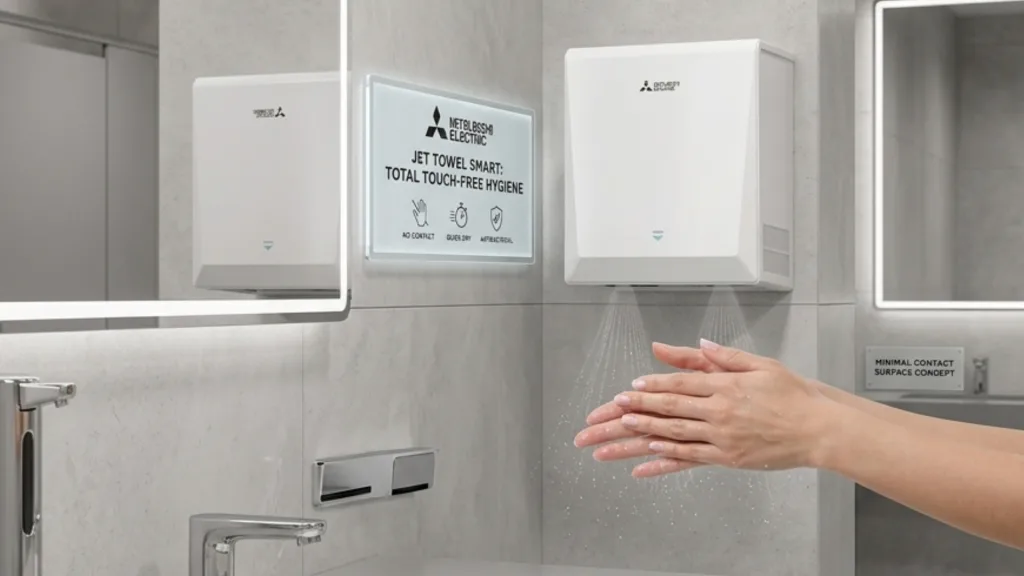
The Mitsubishi Jet Towel, for instance, uses a dual-blade air design combined with HEPA-grade filtration, a specification that addresses the core concerns raised about earlier hand dryer models and makes it a hygienic choice for Malaysia’s healthcare, hospitality, and food service sectors.
For most commercial washrooms offices, malls, hotels, transit hubs a well-maintained, HEPA-filtered hand dryer is at least as hygienic as paper towels, and in many cases more so when you factor in real-world dispenser maintenance and user behaviour. Clinical environments may still favour paper towels as a standard of care, and that is a legitimate distinction.
Paper Towels vs Hand Dryers: Environmental Impact
Sustainability is increasingly a deciding factor for Malaysian property developers, corporate tenants, and building certification bodies. Both hand dryers and paper towels carry environmental footprints but they are not equal.
Paper Towels and the Waste Problem
Malaysia generates millions of tonnes of solid waste annually, and single-use paper products are a significant contributor. For washrooms:
- Paper towels are almost never recycled they are contaminated by moisture and often mixed with other waste
- Manufacturing paper towels requires timber, water, and significant energy
- Transportation and storage add further carbon to the supply chain
- Each tonne of paper towel waste sent to landfill produces methane as it decomposes
A busy shopping mall in the Klang Valley might go through thousands of paper towels daily across multiple washrooms adding up to tonnes of landfill waste per year from this single category alone.
The Hand Dryer’s Environmental Case
Electric hand dryers, particularly energy-efficient models, have a considerably lower lifecycle carbon footprint than paper towels when measured per hand-dry:
- Studies from lifecycle analysis researchers consistently show hand dryers produce 70–80% fewer greenhouse gas emissions per use than paper towels
- Modern jet-style dryers use as little as 550–1,000W and complete a cycle in under 12 seconds meaning actual energy consumption per use is very low
- The unit itself lasts 7–10 years with standard maintenance, meaning the manufacturing carbon is amortised over an enormous number of uses
For buildings pursuing GreenRE, Green Mark, or LEED certification in Malaysia increasingly relevant for new commercial and mixed-use developments switching from paper towels to efficient hand dryers can contribute meaningfully to sustainability scores and corporate ESG reporting.
Why Ditching Paper Towels Improves User Experience
Numbers tell one story. But how users actually feel about your washroom tells another and in hospitality, retail, and corporate environments, perception matters enormously.
Speed and Convenience
This is where modern hand dryers have made the most dramatic gains. The criticism of older warm-air dryers that they were slow, ineffective, and caused users to wipe hands on clothing no longer applies to high-performance jet models.
- Drying time of 8–12 seconds is comparable to using 1–2 paper towels
- No waiting in line for a dispenser to be restocked
- No wet hands touching door handles after fumbling with a towel bin
For high-volume venues, LRT stations, stadium concourses, airport terminals hand dryers also scale better. Multiple units can be installed along a wall, handling peak traffic without the restocking bottleneck that comes with paper towel dispensers.
Aesthetics and Cleanliness Perception
Overflowing bins. Wet paper towels on countertops. Half-open dispenser doors. These are the visual cues that make washrooms feel neglected and they are almost exclusively associated with paper towel setups.
A hand dryer installation, by contrast, presents a clean, uncluttered wall fixture. There is no waste to overflow, no surface mess, and no visual signal of neglect. For premium venues in Malaysia luxury hotels, flagship retail stores, corporate headquarters this cleaner visual aesthetic genuinely enhances how the space is perceived.
Accessibility Considerations
Both formats need to be configured thoughtfully for users with mobility or disability considerations. Hand dryers should be positioned at accessible heights, with sensors that respond to users in wheelchairs. Some Jet Towel models are specifically designed with compact, low-profile housings that work well in accessible washroom designs.
When Paper Towels Still Make Sense
A balanced comparison requires honesty about scenarios where paper towels remain the better choice. Not every environment is suited to hand dryers, and acknowledging this makes the overall guidance more useful.
Situations Where Paper Towels Have the Edge
- Clinical and sterile environments: Hospitals and medical clinics in Malaysia often retain paper towels in procedure areas, where the friction-drying benefit and the complete absence of shared air streams remain clinical preferences
- Small, low-traffic facilities: If a washroom sees fewer than 20–30 uses per day, the ROI on a hand dryer unit is much slower, and a simple towel dispenser may be operationally simpler
- Temporary or portable facilities: Events, construction sites, and pop-up washrooms where infrastructure for hand dryer installation is not available
- Emergency backup: Some facilities choose to maintain a small paper towel backup dispenser alongside hand dryers for situations where power is unavailable or a unit requires servicing
These are legitimate use cases and acknowledging them makes the recommendation more credible rather than less.
Conclusion
The hand dryer vs paper towels debate is not a binary win-lose. But for the vast majority of commercial, hospitality, retail, and corporate washrooms in Malaysia, the evidence points decisively in one direction: a high-quality hand dryer is the more cost-effective, more sustainable, and increasingly more hygienic choice particularly when that dryer incorporates modern filtration, touchless operation, and high-velocity airflow.
Paper towels served us well for decades. But the technology available today especially in the premium tier of jet dryers has fundamentally changed the equation. The operating savings are real. The environmental benefits are measurable. And the washroom experience, when done well, reflects positively on every facility that makes the upgrade.
If you’re ready to move beyond paper towels and explore what a high-performance hand dryer solution looks like for your Malaysian property, start with the Mitsubishi Jet Towel series at eumation.com. For a broader look at hygiene and washroom solutions, visit eumation.com to explore the full product range and get in touch with their team.