
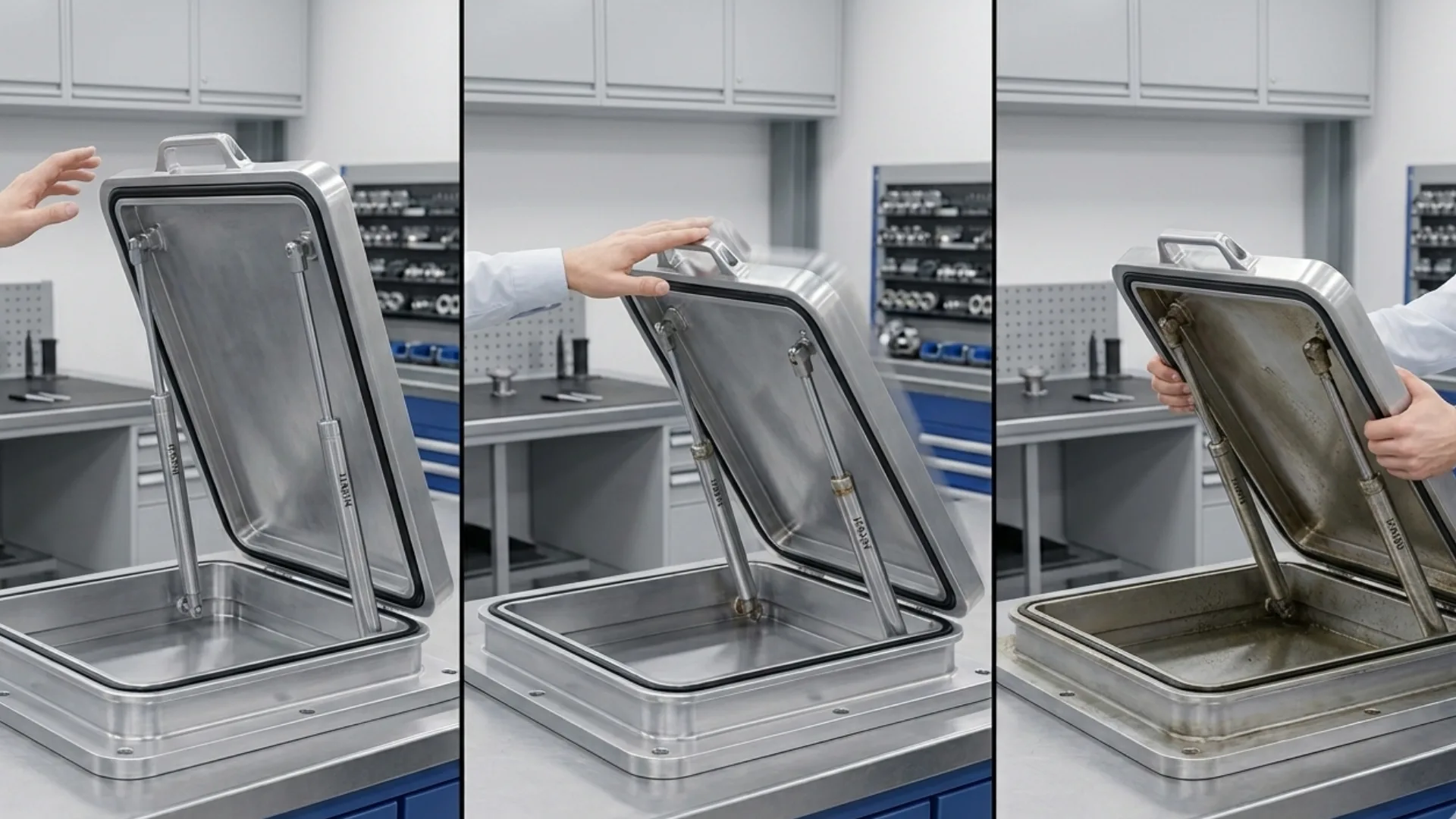
A gas spring not working is more than a minor inconvenience in an industrial or commercial setting, it can mean a machine cover that drops unexpectedly, a production fixture that fails to return, or a piece of equipment that becomes unsafe to operate. For maintenance engineers and facilities teams in Malaysia, tracking down the root cause quickly is critical: every hour of unplanned downtime has a real cost, and a failed gas spring that is left unaddressed is a workplace safety risk.
The frustrating reality is that a gas spring not working rarely gives much warning before failure occurs. One day the lid stays open; the next day it sags, drifts, or drops entirely. Understanding why this happens whether it is a sealing failure, a specification error, a mounting problem, or simply end of service life determines whether the fix is a straightforward replacement or whether there is a deeper systemic issue to address.
This guide covers every common reason behind a gas spring not working, how to diagnose the problem correctly, and how to ensure the replacement or redesign delivers the service life you actually need. If you are already at the replacement stage, the Hahn Gasfedern industrial gas spring range available through Eumation covers the breadth of specifications needed for most Malaysian manufacturing and commercial applications.
Why Is Your Gas Spring Not Working?
By a significant margin, the most frequent cause of a gas spring not working is loss of internal gas pressure through a failed or degraded seal. Understanding how this happens and why is the foundation of any meaningful diagnosis when dealing with a gas spring not working in industrial or commercial applications.
How the Seal Fails
A gas spring relies on a precisely engineered piston rod seal to contain the compressed nitrogen gas inside the cylinder. This seal is typically made from polyurethane or PTFE-based compounds and is designed to maintain a gas-tight barrier across hundreds of thousands of operating cycles.
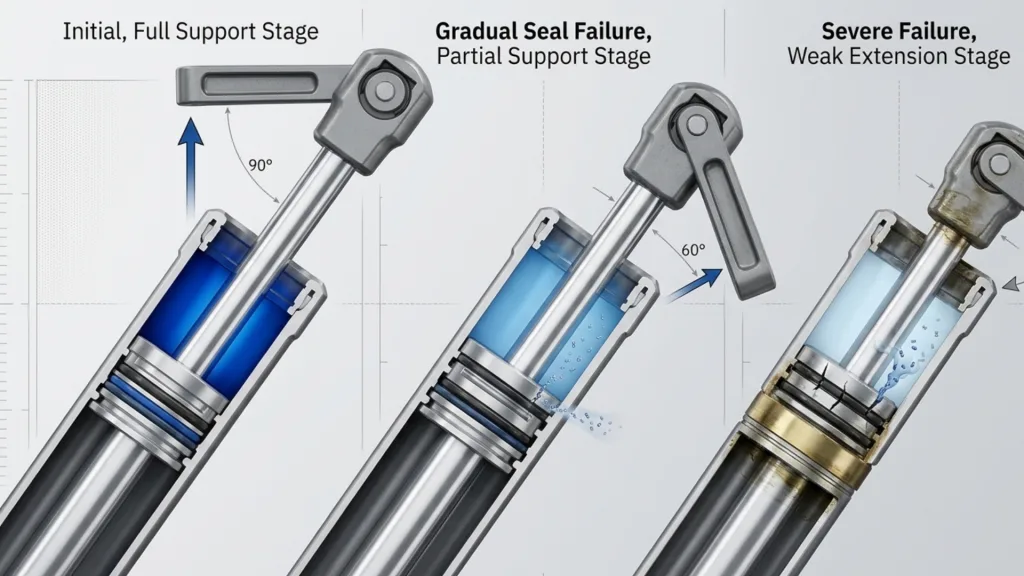
When the seal fails, nitrogen escapes past the rod, pressure drops, and the spring progressively loses its extension force. The failure mode follows a consistent pattern:
- Early stage: The gas spring feels weaker than expected. A lid or cover that previously held itself fully open now only stays at around 70–80% open before slowly drifting down.
- Mid-stage: The spring no longer holds the load at all. The component it was supporting must be propped manually.
- Late stage: The spring offers virtually no resistance and may feel loose or hollow when compressed by hand.
What Causes Seal Degradation
Several conditions accelerate seal wear beyond the normal expected service life:
- Rod-up installation without the correct variant when a standard gas spring is mounted with the piston rod pointing upward, the internal oil that lubricates the rod seal drains away from the seal interface. Without lubrication, the seal wears rapidly. Always use a rod-up-specific variant or confirm the unit is rated for that orientation.
- Contamination on the rod surface grinding swarf, weld spatter, chemical residue, or dried lubricant that has not been cleaned from the rod surface can score the seal lip with each stroke, creating a leak path.
- Lateral loading side loads on the piston rod cause uneven contact pressure on the seal, wearing it asymmetrically. This is one of the most common causes of premature seal failure in Malaysia’s fabrication and tooling environments, where gas springs are sometimes installed without properly verifying the load direction geometry.
- Chemical attack solvents, cutting fluids, and cleaning agents that contact the rod seal can degrade the seal compound over time. This is particularly relevant in food processing, pharmaceutical manufacturing, and surface treatment facilities.
- Thermal cycling repeated exposure to high temperatures followed by cooling common in Malaysian industrial environments where equipment sits in direct sun or near heat sources causes thermal expansion and contraction of the seal compound, gradually reducing its sealing effectiveness.
Confirming Seal Failure
To confirm that gas pressure loss is the cause, apply a small amount of soapy water or leak detection fluid around the base of the rod where it enters the cylinder. If bubbles form during or after compression, the seal is leaking. In most cases, a leaking gas spring cannot be economically repaired on-site the nitrogen pressure must be recharged and the seal replaced under controlled factory conditions. For standard commercial units, replacement is almost always the more practical path.
Gas Spring Not Working Due to Wrong Specification
Not every gas spring failure is a mechanical breakdown. A significant proportion of gas springs that appear to have stopped working were never correctly specified in the first place and the failure is simply the application catching up with the mismatch.
Under-Specified Extension Force
If the gas spring’s extension force (F1) is insufficient for the load it is counterbalancing, the spring will appear to “stop working” but in reality, it was never capable of doing the job. Signs of under-specification include:
- The component the spring supports has always felt slightly heavy to open and slow to stay up
- The spring has never held the load at a fully open angle, only at intermediate positions
- Multiple units of the same spring installed in the same application all show the same behaviour
The fix here is not replacement with an identical unit it is recalculating the required force and specifying a higher-rated spring.
Temperature-Induced Force Loss
Malaysia’s tropical climate creates a specific specification challenge that engineers from cooler climates sometimes overlook. Gas spring extension force is temperature-dependent: it decreases as ambient temperature drops and increases as temperature rises. However, for equipment that starts cold early morning factory start-ups where air-conditioned buildings have cooled overnight a spring specified at standard tropical ambient temperature (30–35°C) may produce noticeably lower force at 20°C, and may genuinely fail to hold the load.
The Hahn Gasfedern range provides force-temperature curves for their products, allowing engineers to verify that the selected unit will perform adequately across the full operating temperature range of their application not just at a single reference condition.
Stroke and Length Mismatches
A gas spring that bottoms out before the supported component reaches its intended open position is functionally broken even if the unit itself is in perfect mechanical condition. This occurs when:
- The stroke was measured incorrectly during specification
- The mounting geometry changed between design and installation
- A replacement unit of a different stroke was installed without checking compatibility
In each case, the unit is not failing the specification is. Careful measurement and cross-referencing against the original design intent will reveal whether the spring or the installation is the problem.
Installation Errors That Cause Gas Spring Not Working
A correctly specified gas spring installed incorrectly will fail earlier than expected sometimes much earlier. These are the installation errors most commonly responsible for gas springs not working as intended.
Misaligned Mounting Points
The most damaging installation error is misaligned mounting points that force the gas spring to operate at an angle to its stroke axis. Even a few degrees of persistent angular misalignment generates lateral force on the piston rod and rod guide with every cycle, causing accelerated wear on the rod guide bushing and uneven loading on the seal.
In practice, this is detected by examining the rod for uneven wear marks, or by checking whether the end fittings can pivot freely throughout the full stroke without binding. If an end fitting is binding reaching its angular limit before the component reaches full open or full closed the mounting geometry must be redesigned rather than simply replacing the spring.
Over-Tightened or Incorrect End Fittings
Ball socket end fittings the most common type must be able to pivot freely. An end fitting that has been over-tightened against a mounting pin, or installed on a pin with the wrong diameter, restricts the pivoting motion and transmits bending loads into the rod. Always verify that end fittings are installed per the manufacturer’s torque specification and that pin diameters match the socket bore precisely.
Failure to Account for Compressed Length
A gas spring forced to compress beyond its rated stroke because the supporting structure allows the component to travel further than the spring can accommodate will bottom out, creating an impact load on the cylinder end cap with every cycle. Over time, this damages the internal stop mechanism and can crack the cylinder body. If the supported component can physically travel beyond the spring’s compressed length, a travel limiter or positive stop must be installed on the component, not on the spring.
Gas Spring Not Working or Just End of Service Life?
Not all gas spring failures represent a problem to be solved sometimes a spring stops working because it has reached the end of its rated service life, and replacement is simply the correct next step. Recognising this as a normal maintenance event rather than a failure helps maintenance teams plan proactively rather than react to unplanned downtime.
Understanding Cycle Life Ratings
Industrial gas springs carry cycle life ratings typically expressed as total number of cycles to expected seal degradation at rated load and temperature. Standard units might be rated for 50,000–100,000 cycles; premium industrial variants can reach 500,000 cycles or more. For a machine cycling 200 times per shift across two shifts per day, 100,000 cycles represents roughly 250 working days less than a year and a half of operation.
Maintenance teams that track installation dates and estimate cycle counts can schedule gas spring replacement as planned preventive maintenance replacing units before they fail rather than after. This approach eliminates the safety risk of a sudden loss of function and reduces the disruption of unplanned replacement.
Signs of Natural Service Life End vs Premature Failure
Distinguishing end of service life from premature failure matters because the response is different:
- End of service life: Force has declined gradually and proportionally. No unusual wear marks on the rod. No visible damage to end fittings or mounting hardware. Unit has been in service for an appropriate number of cycles given its specification.
- Premature failure: Force declined faster than expected. Rod shows scoring or uneven wear. End fittings show binding or damage. Unit has not reached its rated cycle count.
Premature failure always warrants investigation either the specification was wrong, the installation had errors, or the operating environment exceeded the unit’s rating.
Gas Spring Not Working: A Step-by-Step Action Plan
When a gas spring stops working in a Malaysian industrial or commercial setting, a structured response prevents rushed decisions and ensures the replacement performs as expected.
Step 1: Confirm the Failure Mode
Before ordering a replacement, determine whether the failure is due to gas leakage (perform the soapy water test), specification mismatch (recalculate required force and compare against installed unit rating), or installation error (check mounting alignment and end fitting freedom). Each failure mode requires a different response.
Step 2: Document the Original Specification
Locate the part number, force rating, stroke, compressed and extended lengths, and end fitting configuration of the failed unit. If this information is not available from maintenance records, measure the physical unit directly. Replacing a failed gas spring with an incorrect substitute is a common and avoidable error.
Step 3: Review Whether the Specification Should Be Upgraded
Replacement is the right moment to ask whether the original specification was adequate, or whether the service history suggests a change is warranted higher force, different seal material, rod-down orientation, or a premium cycle-life variant.
Step 4: Source from a Reputable Supplier with Technical Support
Generic or counterfeit gas springs are prevalent in the Malaysian market and frequently fail to meet the force ratings and cycle life stated on the packaging. For applications where gas spring failure creates a safety risk, sourcing from an authorised distributor with verifiable product documentation is not optional. Eumation distributes both Hahn Gasfedern and Stabilus gas springs two of the industry’s most respected brands giving Malaysian engineers access to properly documented, traceable products for both standard and demanding applications.
Conclusion
A gas spring that has stopped working is a symptom, not a diagnosis. The underlying cause seal failure from lateral loading, an under-specified force rating, a mounting alignment error, or a unit that has simply reached its cycle life determines the correct response. Replacing a failed spring with an identical specification without investigating the failure mode often results in the replacement failing for the same reason within a similar timeframe.
The path to reliable, long-service gas spring performance in Malaysian industrial applications runs through correct specification, proper installation, environmental awareness, and proactive maintenance planning. When any of those elements is missing, the spring will eventually stop working before its time.
If your operation needs technical support selecting the right gas spring for a new application or identifying the correct replacement for a failed unit, the team at Eumation can assist. Explore the Hahn Gasfedern gas spring range to begin your search, and visit About Us to learn more about the engineering expertise behind their product recommendations.